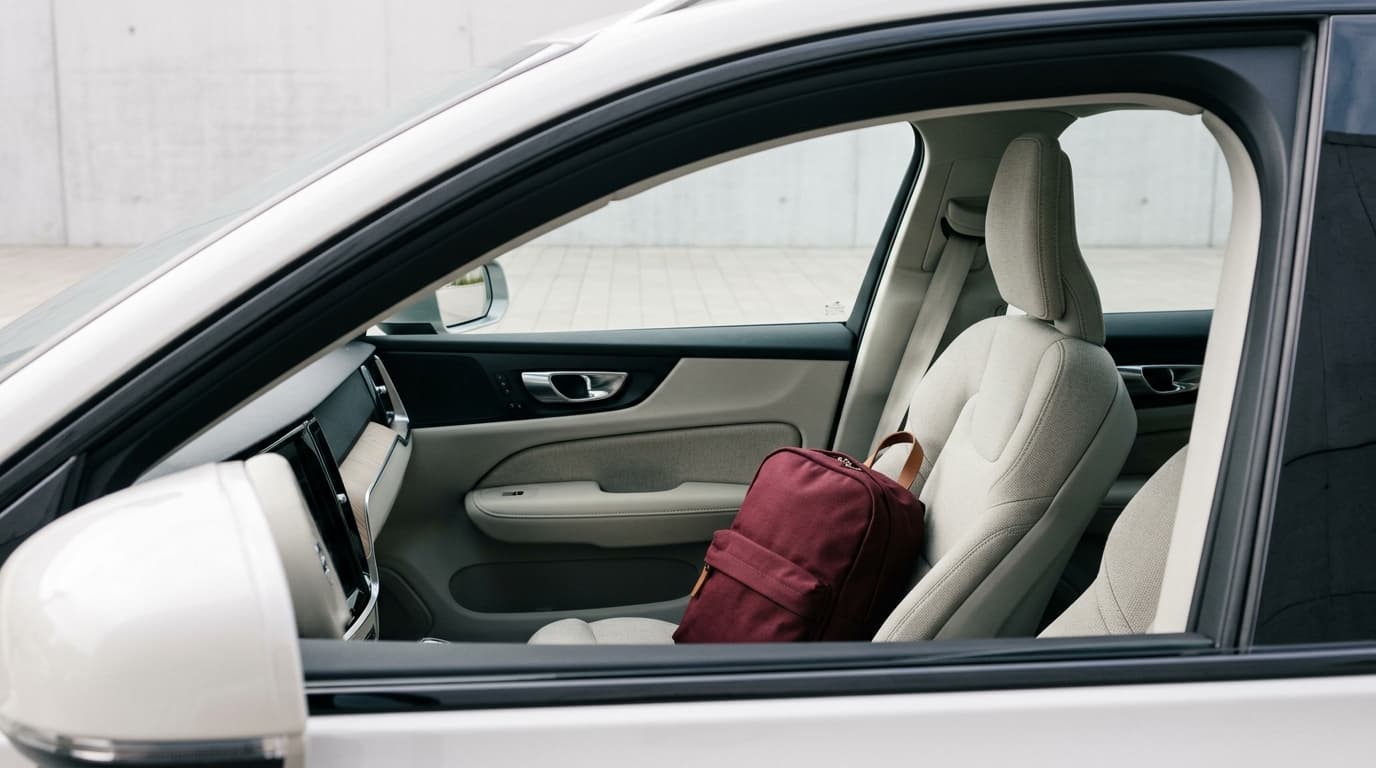
Most of the time, nobody pays for the contents. Omnium and mini-omnium in principle pay for the broken window and the forced lock, not the bag or the laptop. Home insurance only steps in if you took the theft option, and only in two precise cases: a mugging, or an extension that expressly names the car in your conditions.
A broken window, a missing bag: where it starts
Take an ordinary case, the one that comes up most often in the questions I receive. One Tuesday evening, in a gym car park in Namur, someone smashes the rear left window of an estate car. They take a backpack from the rear seat, a laptop tucked inside it, and the child seat, because it was there. Back at the car, the owner adds it up, in round and purely illustrative figures: 380 euros for the window, 1,100 euros for the laptop, 250 euros for the bag and its contents, 220 euros for the seat. Total: 1,950 euros.
His first thought: « I have an omnium, I'm covered. »
His second, after a phone call: « What about my home insurance? »
Both reflexes make sense. Both, most of the time, run into an exclusion nobody read when signing. To settle it, I went back to five public documents from Belgian policies, two motor and three home, and looked for one thing only: what happens to the items inside the car at the moment of the theft?
Does car insurance pay for items stolen from the car?
No, in principle. It pays for the car, and only the car.
Assuralia, the professional union of Belgian insurers, puts it plainly in its FAQ: the omnium protects against theft of the vehicle itself and against damage from an attempted theft, « mais non contre le vol des objets se trouvant à l'intérieur », that is, not against theft of the items inside. Those items are « bagages », and the federation names laptops, cameras, GPS units and mobile phones.
Product fact sheets confirm it, line by line. Yuzzu's, dated January 2026, with the risk carried since then by AXA Belgium, excludes from its three omnium formulas « les effets et objets personnels transportés » (personal belongings carried) and « les accessoires qui ne sont pas fixés définitivement au véhicule » (accessories not permanently fixed to the vehicle). The child seat falls into the second category, the laptop into the first. I covered that fact sheet in detail in the article on Yuzzu car insurance.
Car insurance is not useless that evening, though. The broken window falls under glass cover, included in both mini-omnium and full omnium, and the forced lock falls under theft or attempted theft cover. With liability cover only, by contrast, nothing moves: third-party liability pays for damage you cause to others, never for damage you suffer. The exact scope of glass cover, and its deductibles, are explained in our article on glass cover.
Five policies read, one clause that names the car
Here is the survey, made on 19 October 2026 from public documents. It says nothing about your own policy: it shows the range of answers, and how rare the one that actually protects the contents is.
| Policy | Line | Items left in the car | Published condition or cap | Document |
|---|---|---|---|---|
| Yuzzu mini omnium, omnium essentium, full omnium | Motor | Excluded | Personal belongings and unfixed accessories excluded from all three formulas | Fact sheet, January 2026 |
| AG Top Omnium, sold by BNP Paribas Fortis | Motor | No contents cover among the published insured risks | Vehicle theft excluded if the required anti-theft system was not activated | Product page, October 2026 |
| Baloise Habitation Select, Theft and vandalism option plus Leisure Pack | Home | Covered, theft and vandalism, worldwide | 6,250 euros maximum; items not visible from outside; no business use | Product page, conditions B2053 06.26 |
| Ethias Home Insurance, Theft and vandalism option | Home | Not mentioned; theft of and damage to cars excluded | Theft with violence or threats covered worldwide; report within 10 days | Fact sheet 09/24 |
| AG Top Habitation, Theft cover | Home | Not mentioned | Theft with violence or threats covered worldwide; report within 24 hours with police report number | Product page, conditions 21/06/2025 |
One policy out of five. That ratio struck me, and it comes from the way insurers think about risk: a car parked in the street is the most exposed place where you leave belongings, and therefore the one they avoid covering without an extra premium.
Baloise's extension is worth reading to the end. It is not part of the base cover: you first need the Theft and vandalism option, then the Leisure Pack on top. It sets a condition many people will forget on the day, since the items must not be visible from outside. A laptop left on the passenger seat, in plain view, therefore falls outside the cover, while the same laptop locked in the boot stays inside it. And it excludes items used for business, which rules out the work laptop of many employees.
At Ethias, the fact sheet states that contents « déplacé temporairement et partiellement » (moved temporarily and partially) are covered worldwide. It does not say whether a car parked in a car park counts as a place of temporary removal. I draw no conclusion either way: this is exactly the kind of sentence to have clarified in writing before you need it.
Mugging or break-in: the line that changes everything
There is one case where home insurance almost always plays, provided you took the theft option. It is theft committed with violence or threats against you. AG covers it « en rue et partout dans le monde » (in the street and anywhere in the world), Ethias too, and Assuralia names exactly this situation as the way into home insurance for an item stolen in a car, provided the item is part of the insured contents and subject to deductible and caps.
Someone snatches your bag at a red light, window down: theft with violence, home insurance in principle steps in. Someone smashes the window while you are at the cinema: break-in on a vehicle, home insurance only plays if an extension covers the car. Same bag, same thief, two opposite answers.
Theft of the car itself with violence, carjacking, follows a different logic. On the motor side, Assuralia notes that some insurers let you extend theft cover to violent theft and to theft using the original keys. That extension is not automatic, and you find it in the theft chapter of your general conditions.
Child seat, work laptop, keys: the cases that catch people out
Some items appear in almost every claim, and each has its own rule.
- The child seat. For the motor insurer, it is an accessory not permanently fixed, so excluded from the omnium policies read. For the home insurer, it is contents, payable only if an extension covers the car.
- The employer's laptop or phone. It does not belong to you. Your home policy in principle does not cover it, and Baloise expressly excludes business items from its vehicle extension. The employer often has its own equipment insurance, with its own reporting rules.
- The car keys and papers. Their theft costs little in itself, but it weakens what follows: Assuralia recommends having the keys reprogrammed immediately, and a later theft of the car with its original keys may fall outside cover if your policy lacks that extension.
- Cash, jewellery and valuables. Even when cover applies, they have their own sub-limits: Ethias caps jewellery theft at 5,344.49 euros in its fact sheet, AG limits jewellery to 10% of the insured contents.
- Fixed accessories. A factory car radio, bolted roof bars or a towbar are part of the vehicle. They fall under the omnium's theft cover, within the limit of declared equipment.
How do you check both policies in fifteen minutes?
Open your motor and home general conditions side by side, as PDFs, and use text search. Most Belgian documents are in French or Dutch, so the search terms below are given in French. The order runs from most decisive to finest detail.
- In your home particular conditions, first check that the theft option appears among the covers taken out. Without it, nothing below applies.
- Search « véhicule » (vehicle) in the home general conditions. You are looking for a clause extending theft cover to the contents of a car, with its cap.
- Search « visible » and « effraction » (break-in) near that clause: these are the two most common conditions.
- Search « effets personnels », « bagages » and « objets transportés » (items carried) in the motor conditions. Note whether they are excluded from every formula or only some.
- Search « accessoires » to see how your motor insurer treats what is not fixed, and up to what amount it covers what is.
- Search « violence » in both policies to see how theft with assault is handled.
- Note the reporting deadlines: 24 hours at AG, 10 days at Ethias according to their documents, and a police report required almost everywhere.
Our guide to reading particular conditions explains how to navigate these documents. If an insurer refuses, the difference between an exclusion and a forfeiture of cover decides your arguments.
Our example, replayed across three policy combinations
Back to the 1,950 euros in Namur. Assumed deductibles: zero on the window at an approved repairer, 300 euros on home insurance.
| Combination | Window (380 euros) | Items (1,570 euros) | Left for you to pay |
|---|---|---|---|
| Liability only, home insurance without theft option | Not covered | Not covered | 1,950 euros |
| Mini-omnium, home insurance with theft option but no vehicle extension | Covered by glass cover | Not covered, no violence | 1,570 euros |
| Mini-omnium, home insurance with a Leisure Pack type vehicle extension, items out of sight | Covered by glass cover | Covered, 300 euro deductible taken off | 300 euros |
Laptop visible? Back to scenario two.
Should you add an extension, or simply empty your car?
It depends on what you carry, and how often.
A driver who rarely leaves anything in the cabin has no reason to pay for an extension: they gain more by taking everything with them, or by putting things in the boot before arriving at the car park, not once there under the eyes of someone waiting. A family driving every weekend with a pushchair, a child seat, sports bags and a tablet, a self-employed person carrying their equipment, or a commuter parking at a station every day is in a different position. For those profiles, a home extension that names the car is the only real protection for the contents, and its cap should be compared with the value of what actually sits in the boot.
On the motor side, the choice between mini-omnium and full omnium changes nothing for stolen items: both pay for the window, neither pays for the contents in the fact sheets read. Do not pay for a full omnium thinking it protects your laptop.
One last point, because it comes up often. Pure vandalism, a broken window with nothing taken, falls under other covers, dealt with in our article on vandalism. And if the whole car has gone, our sister site explains vehicle theft and how it is compensated (in French).
To compare the theft and glass cover of motor formulas, the comparison tool lines up policies side by side, and the ranking of the best car insurers sets out what each company covers and excludes. The quiz helps you choose the formula suited to your car's age and use.
Assuralia's answer is public: « Mon assurance omnium couvre-t-elle le vol d'objets à l'intérieur de mon véhicule ? » (in French). Belgian policies are governed by the Insurance Act of 4 April 2014, and if you dispute a refusal, the Insurance Ombudsman, the free Belgian complaints service for insurance customers, examines complaints. Insurer documents consulted on 19 October 2026: the Yuzzu motor fact sheet (January 2026), the AG Top Omnium page at BNP Paribas Fortis, the Baloise Habitation Select page, the Ethias Home fact sheet (09/24) and the AG Theft cover page.
This site informs and compares. It is not an insurance intermediary and gives no individual recommendation: your particular conditions, and only they, decide.
Sinistres & démarches comparator
Compare all sinistres & démarches side by side.
Compare now
Frequently asked questions
Grégory conseille des automobilistes belges sur leurs contrats d'assurance depuis plus de dix ans. Il décortique les formules RC, mini-omnium et omnium, compare les compagnies du marché belge et traduit les conditions générales en langage clair. Sa règle : aucune recommandation sans avoir lu les exclusions.