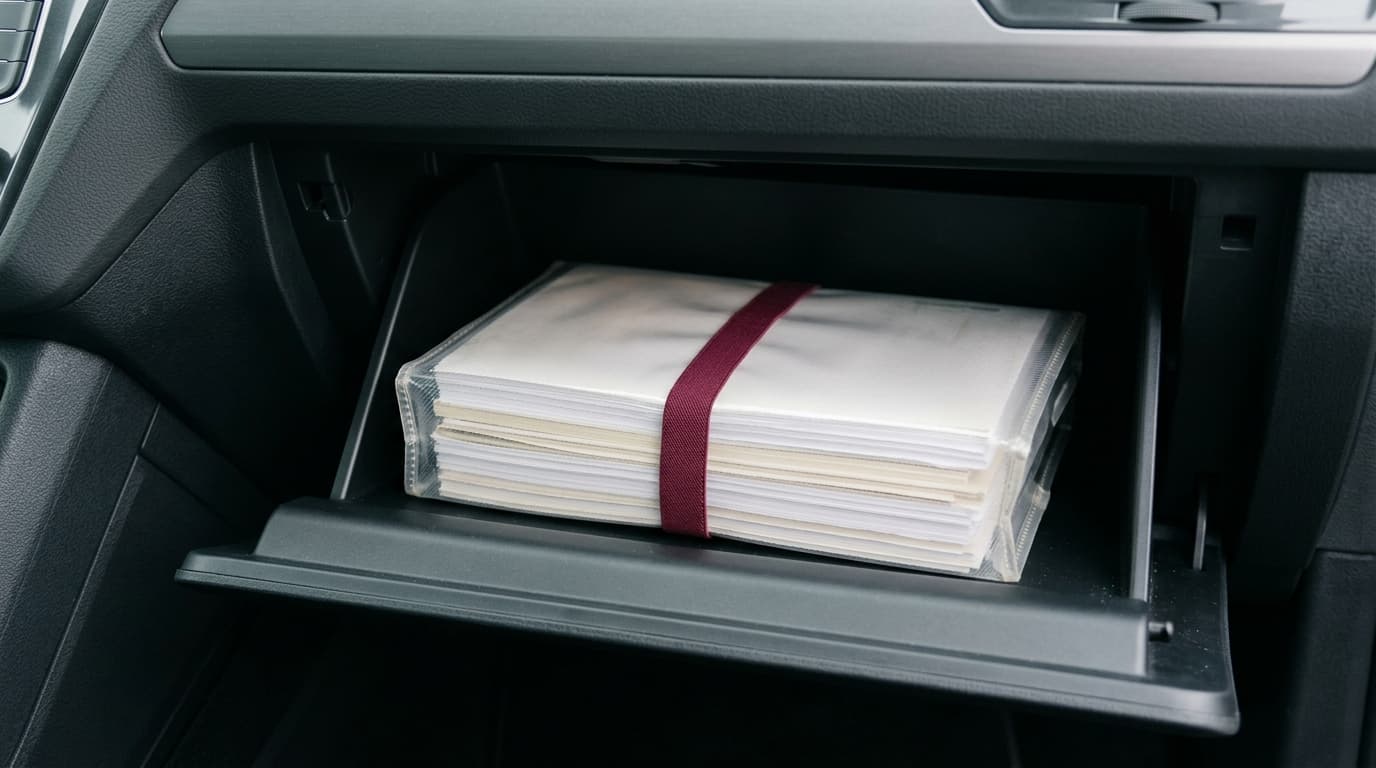
Five documents are mandatory in a car in Belgium: driving licence, registration certificate, insurance certificate, roadworthiness test certificate and certificate of conformity. A forgotten paper is settled with the police. A paper that is no longer valid is settled with your insurer, and the bill is on a different scale.
Which documents are mandatory in a car in Belgium?
One for the driver, four for the vehicle.
The driving licence proves you may drive that category of vehicle; the registration certificate, that the car is registered with the DIV, the Belgian vehicle registration office; the insurance certificate, that compulsory third-party liability cover exists; the inspection certificate, that the car has passed its roadworthiness test if it is over four years old; the certificate of conformity, that it meets technical rules. Your identity card, mandatory from age 15, travels with the licence.
The table below separates two questions that almost every page on the topic blends together: what you risk if the document is missing at a roadside check, and what you risk if it is no longer valid on the day of an accident.
| Document | On board | Validity to watch | Missing at a check | Invalid on the day of a claim |
|---|---|---|---|---|
| Driving licence | Original | Expiry date, category, restrictions | Possible police report | Insurer claims money back, no causal link needed |
| Registration certificate | Vehicle part, original | Holder and plate up to date | Police report, car may be held | No specific recourse in the standard contract |
| Insurance certificate | Paper or digital | Period (box 3), countries covered (box 8) | Minor offence, can be regularised | With no policy in force, it is driving uninsured |
| Inspection certificate | Original, car over four years old | Sticker expiry date | Possible police report | Recourse if a causal link is proven, cancellation possible |
| Certificate of conformity | Original | Matches the vehicle | Possible police report | Non-compliant vehicle: cancellation possible |
The last two columns describe different risks. Read them separately.
Forgotten or expired: which one worries your insurer?
The expired one. By far.
A document left on the kitchen table falls under the highway code. Belgium's federal road police reminded RTBF in July 2023 that when documents are missing, the officer decides, from a verbal remark to a police report with a fine, and the car can be held until the originals are produced. Annoying. Your insurance policy knows nothing about it, and no clause of the standard liability contract penalises a paper left in a drawer.
The insurer looks at the situation the paper proves. The standard contract imposed by the Royal Decree of 16 April 2018 provides, in article 47, a right of recourse with no causal link required against the policyholder and the insured when the car is driven by someone without a valid licence, someone breaking the restrictions written on their licence, or someone under a driving ban. The same article leaves a rarely quoted way out: no recourse when the insured proves the situation stems solely from failing to complete a purely administrative formality.
Does an expired roadworthiness test cost you your cover?
Not for the victims, sometimes yes for you.
Third-party liability cover keeps paying third parties, which is the whole point of compulsory insurance. But article 47, paragraph 1, lets the insurer claim money back from the policyholder when a car subject to roadworthiness testing does not meet the rules and is driven outside the few journeys still allowed, provided it shows a causal link between the vehicle's condition and the accident. Article 30 also lets it cancel the policy when the vehicle has no valid inspection certificate.
The amount follows the scale in article 44. Up to 11,000 euros of net outlay, the insurer recovers everything. Above that, it adds half of whatever exceeds 11,000 euros, with a ceiling of 31,000 euros. The calculation is far from theoretical. Your car, five months past its test date and with bald tyres noted by the assessor, skids on a wet road and hits a stationary vehicle; the insurer pays the victim 18,000 euros, establishes the link between the tyres and the crash, and can claim back 11,000 euros plus half of the remaining 7,000, so 14,500 euros.
No proven causal link, no recourse: a car with an expired test, rear-ended while parked by a distracted driver, does not expose you to this mechanism.
Outside liability cover, the ground shifts. The AXA Belgium assistance conditions examined in the article on breakdown cover (June 2021 edition) exclude a vehicle that is not up to date with its roadworthiness test, with no link to the breakdown required. An omnium policy, the Belgian term for own-damage cover, may hold a similar clause unless your particular conditions say otherwise: search for "contrôle technique" in your general conditions, a ten-second search in the PDF.
Should the certificate of conformity stay in the car?
Yes, on the reading that prevails in Belgium. Test-Achats, the federal police quoted by RTBF and highway code courses all list it among on-board documents, while you can still read here and there that it has become optional. When in doubt, the original stays in the pouch, and the roadworthiness centre will ask for it anyway.
The real dilemma lies elsewhere. Leaving every original in a parked car hands a thief a vehicle complete with its papers. If your registration certificate is issued in two parts, only the vehicle part stays on board; the other one stays at home.
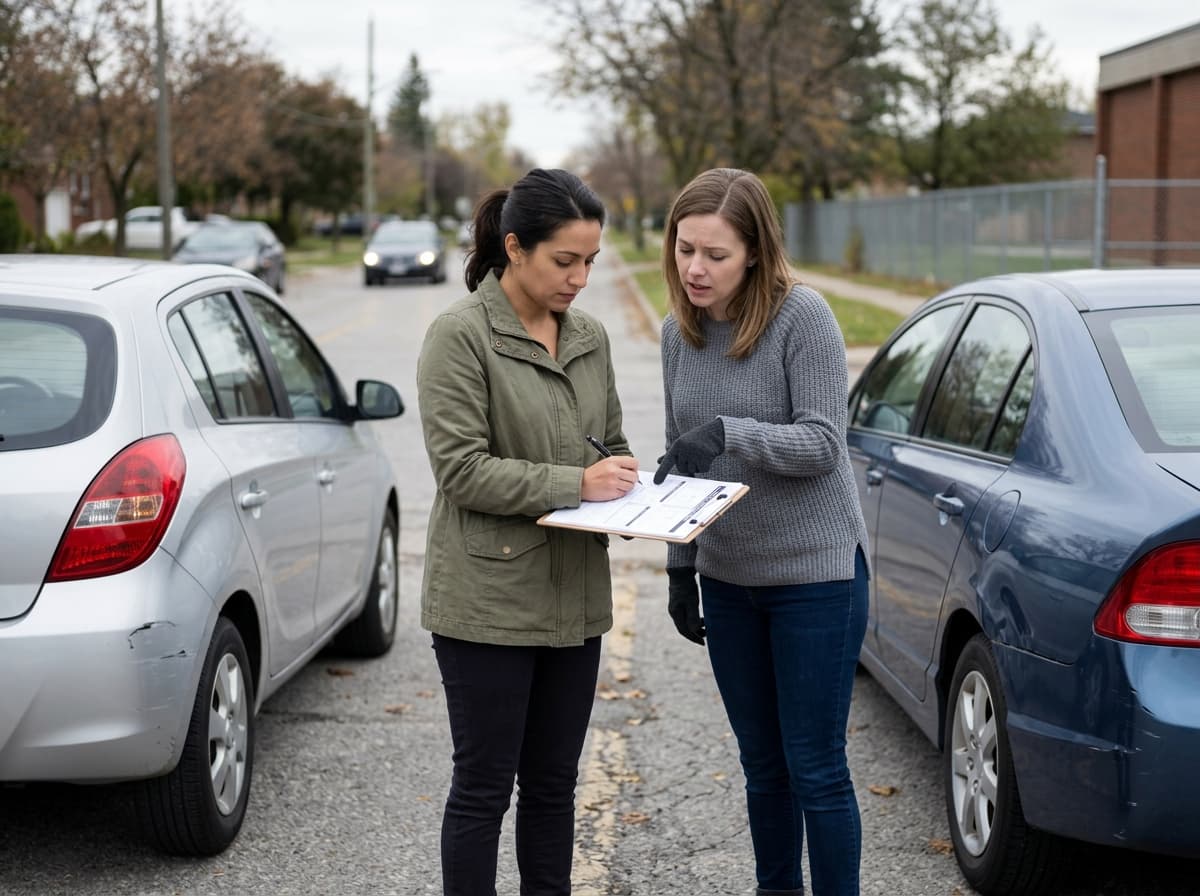
Which extra papers should you keep for your insurance?
The mandatory papers prove you are allowed to drive. These ones help on the day you need the policy to work, and none is required by law:
- two blank European accident reports and a pen that writes;
- a copy of your particular conditions, so you know on the spot whether you hold omnium, assistance or legal expenses cover;
- your policy's assistance number, often separate from the insurer's main line;
- your broker's or agent's contact details;
- invoices for expensive options and accessories, as photos on your phone rather than paper in the glovebox;
- a few dated photos of the car taken when the policy started, bodywork and odometer included.
The last two lines matter most under omnium. An accessory without an invoice or earlier damage without a photo are hard to argue with an assessor, and reading your particular conditions will tell you whether options are only covered once declared.
The deadlines to know before you need them
A deadline discovered after the claim is a deadline already running. The standard liability contract requires every claim to be reported in writing immediately and within eight days at the latest, and any court summons must be passed on within 48 hours. After a theft, omnium is even more pressing: Baloise requires a police complaint within 24 hours, according to its Mobility Safe 1 product sheet dated February 2026.
Six steps to build your on-board pouch
Allow fifteen minutes, once a year.
- Gather the originals of all five documents and check they show the right plate and the right holder.
- Note the expiry dates of the licence, the inspection sticker and the insurance certificate, with a reminder one month before each.
- Check box 8 of the insurance certificate before driving abroad; the details are in the article on the green card.
- Print one page of your particular conditions listing the cover you hold and the useful phone numbers.
- Add two blank accident reports and keep everything in a single pouch.
- Keep your licence and identity card on you, never in the parked car.
Is a copy enough at a roadside check?
No, except for the insurance certificate. Photocopies, even certified ones, are refused, the federal road police confirmed. The insurance certificate is the exception: it can be issued on a durable medium if the policyholder agrees, as the FPS Economy, Belgium's federal economy ministry, points out.
To compare policies on their exclusions rather than their price, the car insurance comparison tool sets cover side by side and the ranking of the best car insurers details what each company covers and refuses. The quiz helps pin down the level of cover you need. If the accident has already happened, the steps are in the article on reporting a claim and the accident report, and the obligations whose breach can void a guarantee are covered in the one on forfeiture of cover.
If you disagree with a recourse claim, the Insurance Ombudsman, Belgium's free dispute service for insurance consumers, examines complaints, and the FSMA, the Belgian Financial Services and Markets Authority, checks that insurers and intermediaries follow conduct rules. These rules describe the general framework: your particular conditions prevail and can adjust it.
This site informs and compares. It is not an insurance intermediary and gives no individual recommendation.
Sinistres & démarches comparator
Compare all sinistres & démarches side by side.
Compare now
Frequently asked questions
Grégory conseille des automobilistes belges sur leurs contrats d'assurance depuis plus de dix ans. Il décortique les formules RC, mini-omnium et omnium, compare les compagnies du marché belge et traduit les conditions générales en langage clair. Sa règle : aucune recommandation sans avoir lu les exclusions.