What is the deadline to report a car insurance claim in Belgium?
You have 8 working days from the accident to report the claim to your insurer. The clock starts on the day of the events, or on the day you became aware of them — for instance if you discover in the morning that your parked car was hit overnight.
In practice, don't wait for the deadline. A file reported within 48 hours is handled faster, the expert can see the vehicle as it is, and witnesses' memories are still fresh. A late report does not automatically cancel your right to compensation, but the insurer may reduce the payout in proportion to the harm the delay caused: a vehicle already repaired and therefore impossible to inspect, an untraceable witness, brake marks washed away. Plenty of reasons not to leave the envelope sitting on a corner of the table.
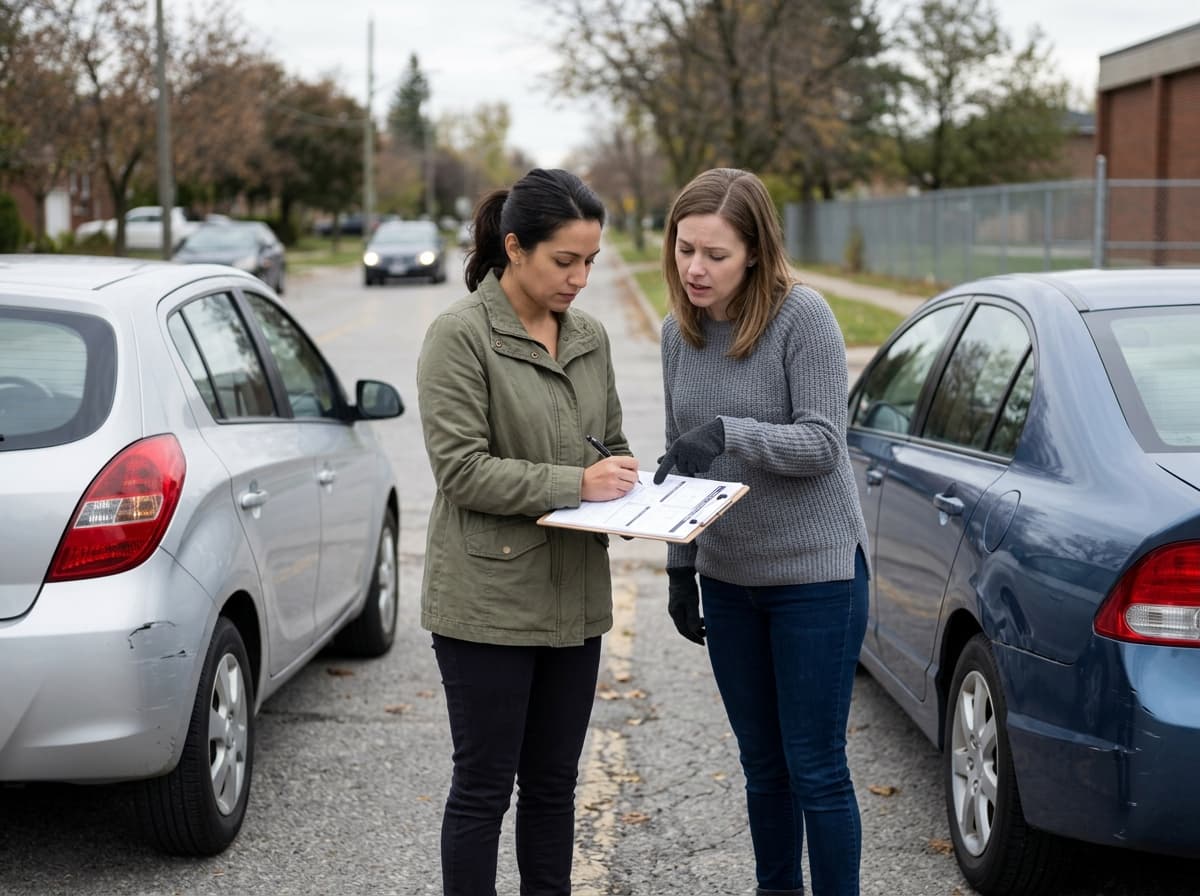
Is the accident report form really mandatory?
No, no Belgian law requires you to fill in a report — but going without one means flipping a coin on your file. The European accident report is a form standardised across Europe: it is the key document companies use to determine who is liable, and in what proportion.
Without a report signed by both drivers, your insurer has only your version of the facts. On the other side, the opposing company has the opposite version. The file then goes into discussion between insurers, sometimes before a judge, and processing can take months. The concrete risk: a default 50/50 split of liability, with everything that implies for your bonus-malus. A properly completed report means ten minutes at the scene that spare you weeks of correspondence.
How do you fill in a European accident report correctly?
The front page is filled in at the scene, with the other driver present; the back can be completed calmly at home before sending it to the insurer. That distinction is the key: what is signed at the scene binds both parties, what comes afterwards is only your own statement.
On the front, you note the date, time, exact location, any injuries, witnesses with their contact details, and the details of both vehicles and both insurance policies. You then tick the circumstance boxes — the heart of the document — draw the sketch and both sign. The Belgian police point out that a report must be legible and complete to be usable. Write in capitals, in ballpoint and never in pencil, with no crossings-out. Count the ticked boxes and write the total in the space provided: that is what stops boxes being added afterwards.
The absolute point of vigilance: never sign a report whose content you do not agree with. If you disagree with the circumstances ticked by the other driver, say so in the "observations" section before signing, or refuse to sign and call the police. Once your signature is on the page, going back is very hard. Belgian companies each publish their own detailed guide — the one from AG Insurance is a good aide-mémoire to read before you need it.
| Item | Where | When |
|---|---|---|
| Identities, plates, policies | Front | At the scene |
| Circumstance boxes | Front | At the scene, before signing |
| Sketch of the accident | Front | At the scene |
| Signatures of both drivers | Front | At the scene |
| Description of damage, photos | Back | At home |
| Sending to the insurer | — | Within 8 working days |
Can you file an electronic accident report in Belgium?
Yes: the Crashform app, launched by Assuralia, the Belgian insurers' professional federation, lets you fill in and sign a report on a smartphone, with the same legal value as paper. You tick the circumstances, add photos of the damage, sign on screen, and the statement goes straight to your inbox, your insurer's and your broker's.
The digital format solves two classic problems: illegible handwriting and forgotten photos. Some green cards now carry a QR code that automatically fills in the insurance details at the scene, removing policy-number transcription errors. Assuralia has also extended the system so a report can be filed from two separate smartphones, each driver staying on their own device. The app is available free on the mobile stores, including the App Store — to be installed before the accident, obviously, not during.
What if the other driver refuses to sign or flees the scene?
Fill in your own copy anyway, document everything, and call the police if the other party refuses to cooperate. A report unsigned by the other side still has value: it fixes your version with a date, which beats a story reconstructed three weeks later.
Note the number plate, the make and model, the colour, the policy number if you managed to see it, and the exact time. Photograph the vehicle positions before clearing the road, the damage from several angles, the road signs and the road surface. Look for witnesses and take their contact details: in a disputed file, a neutral witness often carries more weight than two opposing versions. If there are injuries, a hit-and-run, suspected alcohol or drugs, or total disagreement, the police will attend and their report will replace the accident form.
If the party at fault is never identified or turns out to be uninsured, the Belgian Common Guarantee Fund can step in. For an unidentified vehicle it compensates bodily injury; purely material damage is only covered if the accident also caused serious bodily injury. The practical condition is the same: a well-documented file, with a police complaint and dated evidence.
What happens after you send the notification?
The insurer opens a file, appoints an expert where relevant, establishes liability and then pays out according to the cover in your contract. The timeline depends above all on how clear the report is and how cooperative the opposing company proves.
In practice, you receive an acknowledgement with a file number — keep it, it is your reference for any follow-up. If the damage exceeds a certain amount, an expert inspects the vehicle or the photos before repair: so do not have the car repaired before you get the green light, unless explicitly agreed. Next comes the establishment of liability, between insurers, based on the ticked boxes. Compensation finally depends on your cover: with third-party liability only, only damage caused to others is covered, and your own repairs are down to you if you are at fault. With mini-omnium or full omnium, the cover widens, less the deductible. This is exactly the moment many motorists discover what their contract did not cover; better to know beforehand, by taking the personalised quiz to frame the level of cover that suits your profile.
Does reporting a claim push your premium up?
It is not the report that costs you, it is the liability. A claim where you are not at fault, or damage compensated with no identified liable third party, does not mechanically trigger a malus. An at-fault accident, on the other hand, pushes you up the bonus-malus scale and feeds through to the premium at the next renewal.
Hence the temptation not to report minor damage to "protect your bonus". That calculation sometimes holds up — provided you do it properly: compare the repair cost, the applicable deductible, and the estimated premium increase over three to five years. Below a few hundred euros, paying yourself is often more rational. Above that, it is not. And if a claim has sent your premium soaring, this is the right moment to compare offers: not all Belgian companies penalise a claim the same way, and the gap between AG Insurance, Ethias, AXA, Belfius Direct, KBC, Yuzzu or P&V can be considerable at equal cover.
To go further, see our ranking of the best car insurers in Belgium: it compares, company by company, the extent of cover, the deductible and above all the quality of the claims service — the criterion you always judge too late. And if your contract let you down when it mattered, take two minutes to compare offers based on your profile and your vehicle.
Sinistres & démarches comparator
Compare all sinistres & démarches side by side.
Compare now
Frequently asked questions
Grégory conseille des automobilistes belges sur leurs contrats d'assurance depuis plus de dix ans. Il décortique les formules RC, mini-omnium et omnium, compare les compagnies du marché belge et traduit les conditions générales en langage clair. Sa règle : aucune recommandation sans avoir lu les exclusions.