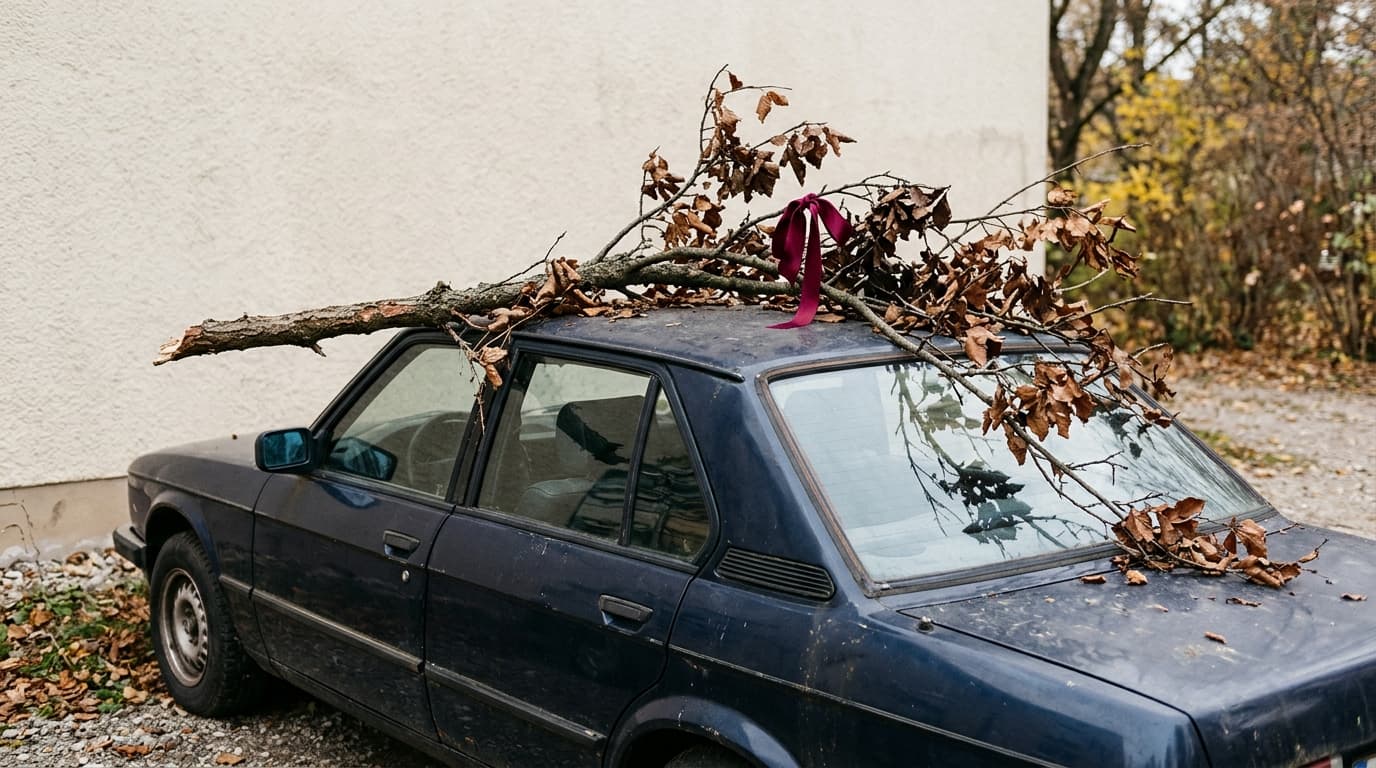
Liability cover pays nothing, the natural forces guarantee usually does. If a tree or branch damages your car, your mini omnium or full omnium pays, provided the wind reaches the threshold written in the contract. With no storm, only full omnium answers, deductible included. The tree's owner rarely pays.
Omnium is the Belgian term for own-damage car cover. Mini omnium is its reduced version, usually fire, theft, glass and natural forces.
Who pays when a tree falls on a parked car?
Your own insurer, if you bought the right guarantee. The table follows the formulas sold in Belgium. It describes common practice, not your policy: only your particular conditions are binding.
| Your contract | Storm (wind above threshold) | Branch in calm weather | Deductible |
|---|---|---|---|
| Liability only | No | No | Not applicable |
| Liability plus nature option | Usually yes | Rarely | Depends on the option |
| Mini omnium | Usually yes | Often no | Often none for natural forces |
| Full omnium | Yes | Yes, via material damage | The omnium deductible, sometimes recoverable |
| No own-damage cover | Regional aid if disaster recognised | No | Not applicable |
The third column is the surprise. It comes from a public complaint filed in December 2025 on the Test-Achats website, which I quote as an unverified account: a driver whose car was hit by a branch faced three successive refusals, wind below the threshold, an amount below the omnium minimum, and the idea of a claim against the municipality. All three grounds appear in ordinary contracts.
At what wind speed does it count as a storm?
Between 80 and 100 km/h, depending on the source and the contract. Test-Achats, the Belgian consumer organisation, says insurers refer to the definition of the IRM, the Royal Meteorological Institute: 100 km/h measured at the nearest weather station. Selectra Belgium uses 80 km/h within 10 km of the vehicle. Both figures exist, so neither exempts you from reading your contract.
Two softer rules come up. Some insurers pay below the threshold when similar damage was recorded very close by. Others accept a local weather reading. Keep proof of the day's weather: a dated screenshot costs nothing.
What about a branch that falls in calm weather?
This is the weak point of most contracts.
A dead branch that gives way without a breath of wind is not a storm. The natural forces guarantee, which requires a weather event, does not apply. That leaves full omnium, which pays material damage whatever the cause, or a claim against the owner if the tree had been left to rot. With neither, you bear the repair.
Driving: is the crash after the fall covered?
Not always. If a branch lands on the car while you drive, you swerve and hit a parked vehicle, the damage from the branch falls under the nature guarantee. The crash that follows is an accident: only full omnium covers it, through material damage, minus the deductible. Mini omnium often stops at direct damage, and your liability cover compensates the owner of the car you hit.
Look for the words "direct" and "indirect" in the definition of the guarantee. Hail works the same way.
Can the tree's owner be held liable?
Yes, but the burden of proof is on you, and it is demanding.
An owner, whether a private person, a co-ownership or a municipality, must maintain trees: trim abnormally large branches, fell a tree that threatens to collapse. If that duty was neglected and the defect caused the fall, liability can be established. The victim proves the defect: dead or hollow tree, earlier warning, older photos. When the tree fell in a storm of exceptional violence, this is in principle force majeure: nobody is liable.
You do not have to run this claim alone. If your omnium paid, the insurer turns against the liable party through subrogation and can recover your deductible. Without omnium, legal expenses cover funds the lawyer and the expert. The mechanism is the same as for a pothole: a negligent manager, proof, a registered letter.
A worked example, with fictional amounts. A branch of an oak reported dead to the municipality crushes the bonnet: quote 3,200 euros, omnium deductible 250 euros. The insurer pays 2,950 euros, then claims 3,200 euros from the municipality. If the claim succeeds, you recover your 250 euros. If it fails, you keep the repair already paid and lose the deductible.
In what order should you act after the fall?
Take the photos before moving the car, the only irreversible step.
- Photograph the tree, the branch, the point of impact and the car, with a street name or house number visible to locate the place.
- Call the fire brigade if the tree blocks the road, and the police if you want a report, useful for a claim.
- Note the weather, a local reading or a screenshot from an app, with the time.
- Report the claim to your insurer or broker, in writing, within the contract deadline. Most summaries mention eight days.
- Have the damage assessed by the insurer's expert before any repair.
- Write to the tree's owner by registered letter, without admitting shared responsibility.
Deadlines by guarantee are set out in the article on claim reporting deadlines, and the general procedure in how to report a claim.
Which evidence to gather, and by when?
| Evidence | Who provides it | When |
|---|---|---|
| Photos of the tree and the damage | You | Before any move |
| Weather reading for the day | You, local station | The same day |
| Police report | Police | If needed, within a few days |
| Damage assessment | Insurer's expert | Before repairs |
| Registered letter to the owner | You | As soon as possible |
Without omnium, is there any help?
Sometimes, from the Region, under conditions. When a storm is recognised as a public disaster, Wallonia, Brussels and Flanders can compensate uninsured property. According to Test-Achats, the car must have been in the street or in circulation, not in a garage or under a carport. The application is made after the recognition is published in the Belgian Official Gazette, by the last day of the third following month at the latest. An early application is not valid. The Wallonia page (in French) explains the procedure.
The lines in your contract that decide
Open the PDF and search, in this order:
- "forces de la nature" or "éléments naturels": if the words are missing, so is the guarantee, whatever the commercial name of the formula.
- "tempête" and its definition, with the wind speed and the measuring radius.
- "chute d'arbres" or "d'objets", sometimes treated separately.
- The deductible specific to this guarantee, often different from the omnium one.
- The minimum claim amount, which some contracts set at several hundred euros.
- The reporting deadline, worth knowing before you need it.
The step-by-step reading of your particular conditions shows where each of these mentions sits.
To line contracts up on these points, the comparison tool sets guarantees side by side. The ranking of the best car insurers details what each company covers and refuses, and the quiz frames the level of protection you need. The formulas are described in mini omnium vs full omnium, and what the first one pays in what mini omnium covers.
Car insurance contracts fall under the Act of 4 April 2014 on insurance. If you disagree with a refusal, the Insurance Ombudsman examines complaints free of charge, and the FSMA, the Belgian Financial Services and Markets Authority, supervises insurers and intermediaries. Sources consulted on 04/11/2026: the Test-Achats storm and car insurance guide, the Selectra Belgium natural disasters page and the compare-assurance.be article on falling trees.
This site informs and compares. It is not an insurance intermediary and gives no individual recommendation: your general and particular conditions, and only they, are binding.
Sinistres & démarches comparator
Compare all sinistres & démarches side by side.
Compare now
Frequently asked questions
Grégory conseille des automobilistes belges sur leurs contrats d'assurance depuis plus de dix ans. Il décortique les formules RC, mini-omnium et omnium, compare les compagnies du marché belge et traduit les conditions générales en langage clair. Sa règle : aucune recommandation sans avoir lu les exclusions.