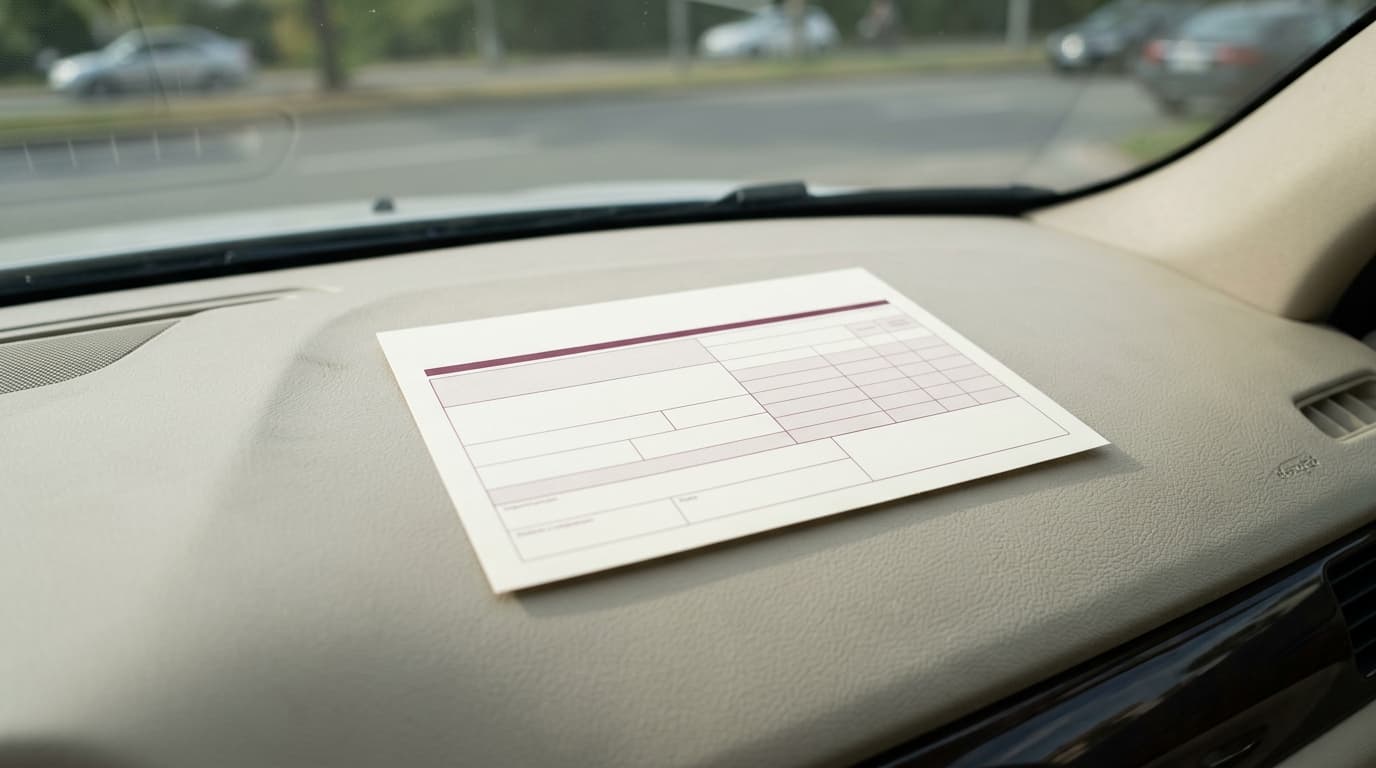
The green card proves third-party liability, never your omnium
The international motor insurance certificate attests one thing: your liability towards third parties is insured. Damage caused to the vehicle described on the card falls under no line of the document. The reference text of the Belgian Motor Insurers Bureau, the BBAA, states it plainly.
Plenty of drivers set off on holiday believing the opposite.
The confusion is understandable, because the card carries the insurer's name, the number plate, the make of the vehicle and a validity period. It looks like an identity card for the policy. It is not one. A windscreen shattered by a stone on a Spanish motorway, a car stolen in Milan, hail damage in the Ardèche: none of that appears on the green card, and none of it is guaranteed by it. Those claims depend on your omnium, whose territorial scope sits elsewhere, in the general conditions.
That is why I never recommend a policy without reading its exclusions first. The green card itself carries no readable exclusion, with one exception: the list of countries in box 8.
White since 2020, digital at the policyholder's choice
The green background disappeared and the name stayed.
The BBAA moved its members to a black-on-white format on 1 July 2020, and since 1 January 2022 no Belgian international card printed on green paper is valid. On that same 1 July 2020 the bureau authorised electronic delivery of the document. A Royal Decree of 11 September 2020 wrote that choice into Belgian regulation.
Article 5 of the Royal Decree of 13 February 1991 now sets out the rule in three sentences: the certificate referred to by the Act of 21 November 1989 is the international motor insurance card issued under the authority of the BBAA, it is delivered free of charge on paper or, if the policyholder consents, on another durable medium, and the policyholder may change that choice free of charge during the policy.
Three words in that sentence deserve underlining. "If the policyholder consents": an insurer that sends nothing but PDFs without having asked you is outside the frame. Ethias, for one, offers a digital certificate in its client portal while keeping paper delivery for those who ask. The choice belongs to you, and it can be reversed at any point at no cost.
Eleven boxes, five that matter
The Belgian card follows a model filed with the United Nations Economic Commission for Europe, which explains its rigidity: no insurer may add information the model does not foresee, apart from the "useful information" section. The layout is identical from Lisbon to Helsinki, which lets a Hungarian police officer read a card written in French without understanding a word of it.
Five boxes decide your actual position.
- Box 3, validity. The year may be written with two or four digits, and neither the hour of issue nor the hour of expiry appears anywhere. A card that expired the day before departure cannot be fixed on the road.
- Box 4, identification. It reads country code, insurer code, number, in that order. The BBAA asks its members to put the policy number there, which makes it the reference to quote on a European accident statement.
- Box 5, the registration. Check that it matches the plate actually fitted to the vehicle, especially after changing cars or while using a courtesy vehicle.
- Box 6, the category. A for car, B for motorcycle, C for lorry or tractor unit, D for moped, E for bus or coach, F for trailer or semi-trailer, G for anything else. The words "and trailer" or "and caravan" may be added there, and their absence costs dearly when towing.
- Box 8, territorial validity. The only box whose content genuinely differs from one policy to the next, and the only one that can leave you uninsured at a border.
One calendar point matters as of recently. A decision of the Council of Bureaux general assembly has banned, since 1 January 2025, the issuing of cards completed or filled in by hand. A handwritten card presented today no longer holds.
Which countries does a Belgian green card cover?
Every country whose code is not struck through with a diagonal cross, the Saint Andrew's cross. The principle fits on one line, its application much less so.
The table below reflects the BBAA position as it applies to Belgian cards. It describes a regulatory standard, not your policy: only box 8 of your own card governs your case.
| Destination | Cover | Code may be crossed | Paper copy |
|---|---|---|---|
| European Economic Area | Compulsory | No | Optional |
| United Kingdom | Compulsory | No | Recommended |
| Switzerland, Andorra, Serbia | Compulsory | No | Recommended |
| Bosnia and Herzegovina, Montenegro | Compulsory | No | Recommended |
| Morocco, Tunisia, Türkiye | Compulsory | No | Required on entry |
| Albania, Moldova, North Macedonia | Optional | Yes | Required on entry |
| Ukraine | Optional | Yes | Required on entry |
| Azerbaijan | Off the Belgian model in 2026 | Box removed | Frontier insurance |
| Iran | Suspended since 2024 | Crossed by default | Frontier insurance |
| Russia, Belarus | Out of the system since 2023 | Crossed by default | Frontier insurance |
Two columns read together. Compulsory cover means the insurer has no right to cross the code out, so the question does not arise for you. Optional cover means it may, and it often does so by default without telling you, because box 8 is filled at issue and nobody rereads it.
May an insurer cross out a country?
Yes, but not just any country, and the list of prohibitions is short and precise.
Any card issued for a vehicle normally based in a state of the European Economic Area must cover the whole EEA territory. A Belgian insurer therefore cannot cross out any of the twenty-seven member states, nor Norway, nor Iceland, nor Liechtenstein. Beyond the EEA, the BBAA also forbids crossing out the codes of Andorra, Bosnia and Herzegovina, Montenegro, the United Kingdom, Serbia and Switzerland, all bound by the multilateral guarantee agreement, along with Morocco, Tunisia and Türkiye, whose cover is imposed by article 4 of the Royal Decree of 16 April 2018 setting the minimum conditions of Belgian motor liability insurance.
That leaves Albania, Azerbaijan, Moldova, North Macedonia and Ukraine. These five destinations fall under section II of the Council of Bureaux internal regulations, their cover is not compulsory, and the insurer may therefore cross out their codes entirely lawfully. A trip to Tirana or Chisinau starts with a call to your company, several weeks before departure, to obtain an extension and a card that is valid there.
Russia, Belarus, Iran, Israel: the codes withdrawn from the model
The card model has changed four times in four years, and nobody is told about it.
Israel left the international card system on 1 January 2022. Since 1 January 2024 the box carrying the IL code must have been removed from the document. Russia and Belarus followed another path: a third of EEA bureaux having terminated their bilateral agreements in 2022, all the others had to do the same, and since 1 June 2023 the RUS and BY codes must be crossed out on every Belgian card. Iran has been suspended from the Council of Bureaux since 1 January 2024, with the same consequence.
Azerbaijan closes the series. Its reference could be omitted from 1 September 2024, and it may no longer appear on a Belgian card from 1 January 2026. A card issued this year therefore carries no AZ box at all.
A driver keeping a 2021 card with an intact RUS code in the glovebox gains no extra cover from it. Validity is assessed at the date of the claim, not at the date of printing.
The cover attested is the one of the country you are visiting
This point is the least understood of the whole subject, and it is better grasped before the accident than during it.
In each country visited, the national bureau guarantees the cover required by local compulsory insurance law. The card does not export your Belgian policy: it gives you the legal minimum of the state you are driving in. That minimum can sit well below yours, notably on the indemnity ceilings for bodily injury, which still vary considerably across Europe.
Belgian law corrects the imbalance in part. Article 40 of the minimum conditions, set by the Royal Decree of 16 April 2018, provides that for a claim occurring outside Belgian territory the cover granted is that of the state where the claim happened, but that applying that foreign law may not deprive the insured of the wider guarantee Belgian law grants. The Belgian floor therefore travels with you. The ceiling of the country visited does not rise.
Is a printed green card still needed?
On paper, no. On the road, often yes.
Since 1 January 2025 every country whose bureau belongs to the Council of Bureaux must be ready to accept a card shown as a PDF on an electronic device. The rule is clear, it is recent, and how it plays out still depends on the officer stopping you three hundred kilometres from home.
Three situations justify the paper copy without argument. A trip to a section II country, where the card conditions the vehicle's access to the territory. A vehicle shared between several drivers, since the document then lives inside one phone only. And a check after an accident, the moment when a damaged or flat smartphone turns a formality into a complication. The BBAA itself recommends printing the document when several people are likely to drive.
A word on penalties, because the subject is handled badly almost everywhere. The heavy fines and vehicle seizure that several industry pages attach to the green card punish the absence of insurance, not the absence of the document. Driving insured without being able to produce the certificate is a separate and much lighter offence, curable by producing proof of the policy. The two situations differ in gravity and in consequence, and conflating them sustains a needless fear.
Four checks before driving abroad
Allow five minutes, card in hand or PDF open.
- Read box 3 and compare it with your travel dates. A card expiring during the trip is replaced before departure, not on return. If the renewal has not arrived as the expiry approaches, chase your intermediary: automatic delivery is not always automatic.
- Go through box 8 code by code, for your destination and for the countries you cross. A road trip to Greece passes through territories that are not all covered in the same way. The Saint Andrew's cross is visible at a glance, and its absence just as quickly.
- Open your general conditions at the territorial scope of the omnium guarantees. The green card says nothing about theft, glass breakage or own damage. Some Belgian policies restrict those guarantees to a geographical zone or to a continuous length of stay.
- Check box 6 if you tow. A trailer or caravan requires the matching wording, or a separate card. The weight of the combination sometimes changes the category of the towing vehicle too.
One remark covers all four points. Your particular conditions prevail over the general conditions, and they are the ones carrying your name, your plate and the options you actually bought. A compliant green card never makes up for a guarantee you did not purchase.
Loss, expiry, and the fifteen-day floor
A little-known international rule protects drivers caught between two policies.
Every international insurance card is issued for an uninterrupted period of at least fifteen days from the start of its validity. A card issued for a shorter period is still deemed valid and guaranteed by the issuing bureau for those fifteen days, including where the policy is cancelled in the meantime. The rule earns its keep when changing insurer or buying a vehicle at the end of a month.
In case of loss, only one address exists: your company, or its agent. The bureau of the country you are visiting issues no renewal, not even on an Italian motorway on 15 August. The duplicate is free, like the original, and usually downloads from the client portal. P&V, Ethias, AXA and most Belgian insurers make it available online.
Compare policies on their scope, not on their card
The green card tells no two insurers apart. They all issue the same document, in the same format, under the authority of the same bureau. The difference is settled upstream, inside the contract.
To set the formulas side by side on what they actually cover, our car insurance comparison tool works guarantee by guarantee, and the ranking of the best car insurers goes company by company through what each one covers and refuses. If the overall level is what you are unsure about, the quiz takes two minutes. The boundary between formulas is covered in our comparison of mini-omnium and full omnium, and the question of glass damage abroad in the article on windscreen and glass cover.
If the claim has already happened abroad, the ground shifts and the question turns procedural: the European accident statement, the insurer's representative in that country, reporting deadlines. Our article on reporting a car insurance claim sets out the steps. On the contractual obligations whose breach can bring a guarantee down, the article on forfeiture of cover walks through the Belgian legal framework.
Compulsory motor liability insurance is governed by the Belgian Act of 21 November 1989 and its implementing Royal Decree of 13 February 1991. The Belgian Motor Insurers Bureau publishes the official description of the card model, and the Federal Public Service Economy gives a plain-language presentation of it. Where a disagreement with a company persists, the Insurance Ombudsman, the Belgian sector mediator, handles consumer complaints free of charge, and the FSMA, the Belgian financial services and markets authority, supervises insurers and intermediaries. The Ethias digital certificate service shows what a card delivered on a durable medium looks like.
One last field marker. When an intermediary assures you that "you are covered everywhere in Europe", ask for the card and look at box 8 together. Any disagreement is settled in ten seconds.
This site informs and compares. It is not an insurance intermediary and gives no individual recommendation.
Sinistres & démarches comparator
Compare all sinistres & démarches side by side.
Compare now
Frequently asked questions
Grégory conseille des automobilistes belges sur leurs contrats d'assurance depuis plus de dix ans. Il décortique les formules RC, mini-omnium et omnium, compare les compagnies du marché belge et traduit les conditions générales en langage clair. Sa règle : aucune recommandation sans avoir lu les exclusions.