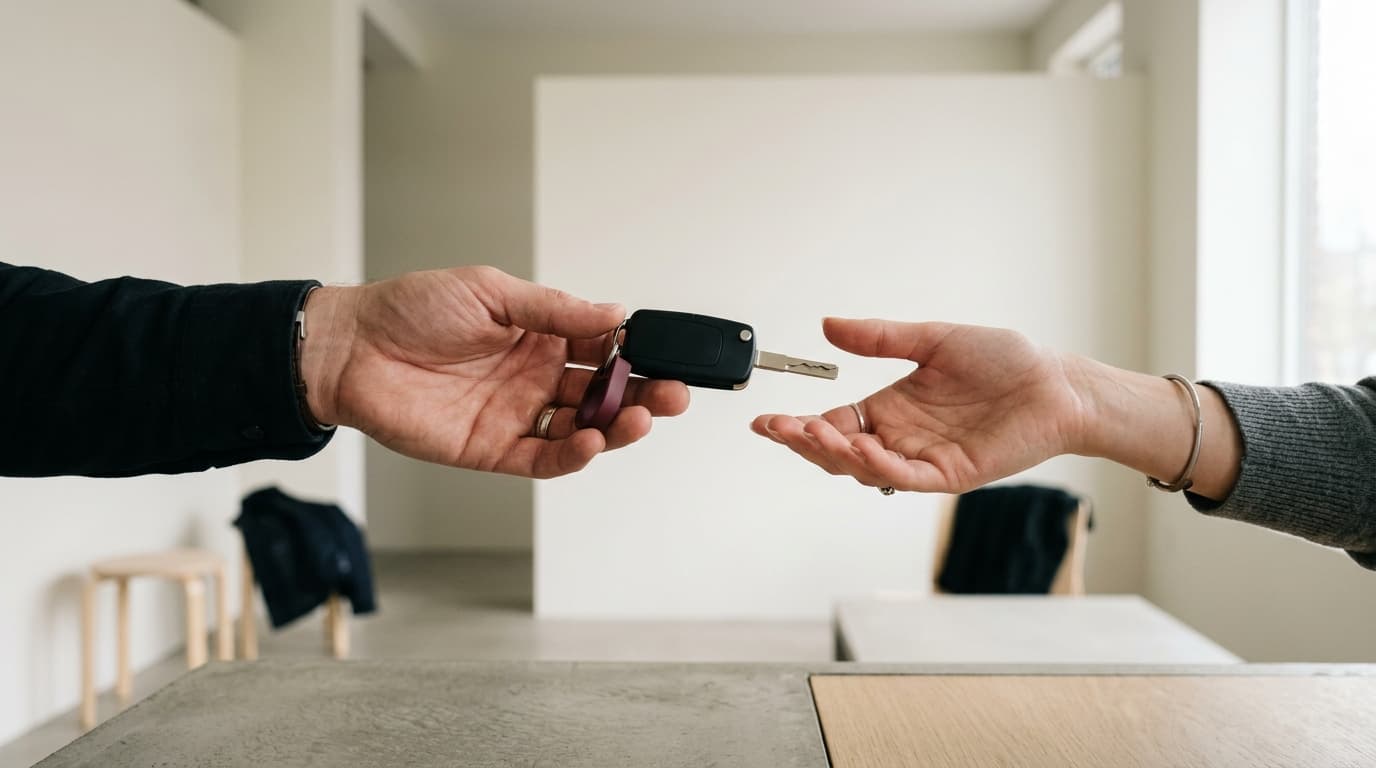
Can I lend my car and stay covered?
Yes. In Belgium, compulsory third-party liability car insurance covers the vehicle, not the person driving it: if you hand your keys to a friend, a neighbour or your son for a quick trip, cover continues to apply without any formality on your side.
That is a reassuring answer, and it is the one you will read on the insurers' own blogs. It is accurate. It is also incomplete, because it suggests that lending a car is a non-issue, whereas the real dividing line lies elsewhere: not between lending and not lending, but between a one-off loan and regular use that you never reported.
Third-party liability follows the vehicle, not the driver
The principle comes from the standard contract imposed by the Royal Decree of 16 April 2018 setting the conditions of compulsory motor liability insurance contracts. Cover is built around the insured vehicle and the people driving it with the owner's consent. In practice, a third party injured in an accident caused by your car is compensated, whoever was driving.
This differs sharply from several neighbouring countries, where insurance is built first around a named driver and lending your vehicle requires paperwork. In Belgium the opposite reflex applies: lending is the default situation, and it is the exclusion you have to go looking for.
You still have to go looking for it.

Who pays what if the person I lent my car to has an accident?
The answer depends on two things only: who is at fault, and which cover you bought beyond compulsory RC. The table below sets out the scenarios, with an order of magnitude for what genuinely stays on your plate.
| Situation | Third-party damage | Damage to your car | What it costs you |
|---|---|---|---|
| Borrower not at fault | Other party's RC | Other party's RC | Nothing, degree unchanged |
| Borrower at fault, RC only | Your RC | Not covered | Full repair + malus |
| Borrower at fault, omnium | Your RC | Your omnium | Deductible + malus |
| At fault, undeclared young driver | Your RC | Your omnium | Deductible often doubled + malus |
| Undeclared habitual driver | Your RC | Depends on cover | Possible recourse for the full amount |
Two rows deserve a pause. The second one first: with RC only, your own car is never compensated when the borrower is at fault, and any arrangement between the two of you is a purely private matter. Then the last one, which is the heart of the subject and which we unpack below.
The serious objection: the undeclared habitual driver
A hurried reader could stop at the first section and conclude there is nothing to do. That is where the reasoning breaks.
The duty to declare concerns the habitual driver: the person who uses the vehicle recurrently, as opposed to someone who borrows it now and then. The distinction is anything but theoretical. If your daughter takes the car every morning to get to work and the policy says nothing about it, the insurer has covered a risk it never priced, and Belgian law gives it a way to claw that back.
That mechanism is the right of recourse. The insurer compensates the victim first, because the law requires it and because an injured third party must never bear the cost of a contractual dispute. It then turns against you to recover the sums paid. On a dented wing, that is unpleasant. On bodily injury with permanent disability, the amounts run into hundreds of thousands of euros, and P&V states it plainly in its file on lending a vehicle: the insurer is entitled to claim back the full compensation paid out.
The nuance, and it works in your favour: this recourse is not automatic. Article 152 of the Insurance Act of 4 April 2014 requires the insurer to notify its intention to seek recourse as soon as it becomes aware of the facts justifying it, failing which it forfeits that right. A late, vague or implicit notification is not enough: Belgian case law requires it to be clear and to leave no doubt about the company's intentions. That is a real protection, almost never explained to consumers, and the first thing to check if a recourse letter reaches you months after a claim.
Should you declare an occasional or secondary driver?
No for an occasional driver, yes as soon as use becomes regular. The problem is that the boundary is written nowhere.
No Belgian legal text sets a numerical threshold. Market intermediaries use a rule of thumb: beyond three uses a month, you leave the occasional category for the habitual one. That is not a rule of law, it is a rule of thumb, and it is worth exactly what your own insurer's general conditions say about the term. Some companies write "habitual driver", others "designated driver" or "main driver", and those words do not cover quite the same thing.
The good news is that declaring costs nothing and takes a minute. An email to your broker is enough to have an extra driver named in the particular conditions. Depending on the profile declared, the premium may be revised upwards, but the gap bears no comparison with the size of a recourse claim.
Lending to a young driver: the deductible doubles
Here is the case where lending costs money immediately, even without any fault on your part.
Several Belgian omnium policies provide for an increased deductible, usually doubled, when the vehicle is driven at the time of the claim by a young person not named in the contract. The age threshold varies: Belfius Direct Assurances applies the doubling below 23, while other companies set the cursor at 26. The logic is always the same — the policy was priced on an experienced profile, and the insurer adjusts the risk-sharing when that profile was not the one driving.
A standard omnium deductible of €500 therefore becomes €1,000 because your 21-year-old nephew helped the family out on a Sunday. Declaring that young driver, even as a secondary one, generally avoids the increase. If this is a daily reality for you, our guide to car insurance for young drivers in Belgium sets out the trade-offs.
Three clauses to look for in your particular conditions
Everything above can be checked in ten minutes on your own policy. Open your particular conditions — the personalised document, not the general brochure — and look for these three points, in this order.
- The exclusive-driving clause. Where it appears, only the people named may take the wheel, and lending the car to anyone else leaves you outside cover. It comes with a premium discount, which is why it sometimes gets signed without much attention.
- The list of declared drivers. Check who appears, under which status (main, habitual, named occasional) and whether a driver who genuinely uses the vehicle every week is missing from it.
- The deductible and its increases. Look for the base amount, then for any specific deductible tied to the driver's age or to their absence from the contract. That is the line that changes the real cost of a claim twofold.
If any of the three is ambiguous, ask your broker to clarify in writing. Where a disagreement with the company persists, the Insurance Ombudsman handles Belgian consumer complaints free of charge, and the FSMA, the Belgian financial services and markets authority, supervises insurers and intermediaries.
Who takes the malus if I was not the one driving?
You do. The bonus-malus degree is attached to the policy, therefore to the policyholder, never to the driver of the day.
An at-fault claim caused by a borrower pushes your own position up the 0-22 scale, and most Belgian insurers have kept the historical mechanics: five degrees up per at-fault claim, one degree down per claim-free year. In other words, a single mistake made by somebody else wipes out five years of faultless driving, and the effect shows on your premium for all that time. Our article on the Belgian car insurance bonus-malus explains the calculation degree by degree.
That is the most concrete argument for thinking about who gets your keys. Not the fear of being uncovered: the deferred cost.
What to do before lending your car
That leaves the most common case, lending to a family member, which is also the most slippery, because a favour turns into a habit without anyone deciding anything. The son who borrows the car for an exam ends up taking it three times a week, and the contract has not moved. Book yourself an annual date with your particular conditions.
If that reading shows your policy is more restrictive than you thought, two useful reflexes: compare market offers on actual cover rather than on the advertised premium, and consult the ranking of the best car insurers, which details company by company the terms offered to households with several drivers. The quiz takes two minutes if you are unsure which level of cover suits your situation.
Profils conducteurs comparator
Compare all profils conducteurs side by side.
Compare now
Frequently asked questions
Grégory conseille des automobilistes belges sur leurs contrats d'assurance depuis plus de dix ans. Il décortique les formules RC, mini-omnium et omnium, compare les compagnies du marché belge et traduit les conditions générales en langage clair. Sa règle : aucune recommandation sans avoir lu les exclusions.