
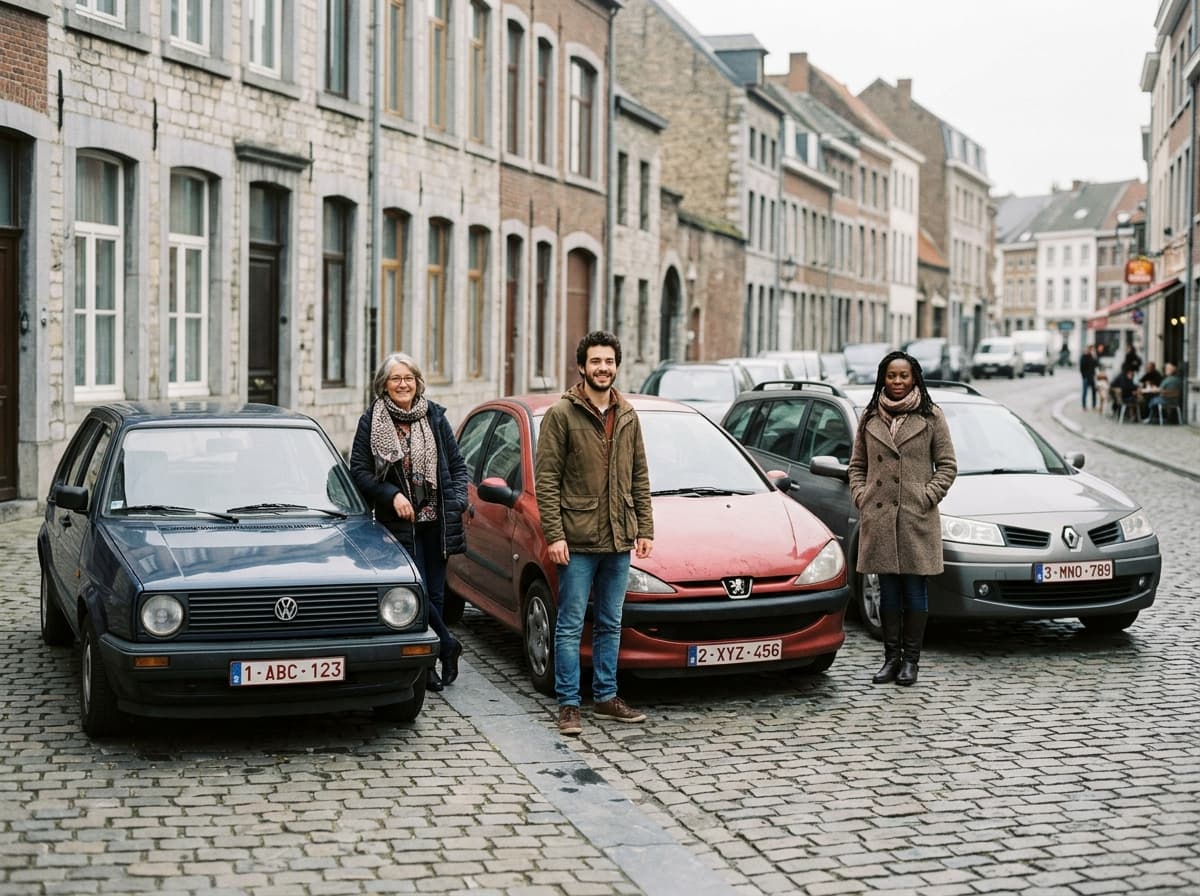
A Belgian resident may not, in principle, drive a foreign-registered car in Belgium, and no insurance policy fixes that. A Belgian insurer expects a Belgian plate. A foreign insurer expects a policyholder living in its own country. Between the two, the rule that decides is residence, never price.
This article covers the foreign-plated car driven in Belgium. If you are leaving Belgium in a Belgian car, read about the green card instead.
Insurance follows registration, which follows your address
When someone asks me "how do I insure my German car in Belgium?", I answer with another question: where do you live?
The request always starts with insurance, and that is the mistake. The real order is the reverse. Your address determines the country where the car must be registered, registration determines which insurer can lawfully cover you, and insurance comes last. Shopping for the best cover before settling the first two steps is like choosing the colour of a roof without a building permit.
That is my thesis, and I defend it with Belgian texts rather than impressions.
What does Belgian law say about foreign plates?
As soon as a new resident joins the national register, the vehicle must be registered with a Belgian plate at the DIV, the Direction pour l'Immatriculation des Véhicules, Belgium's vehicle registration authority.
Wallonia's public service states that enforcement officers grant a tolerance of 30 calendar days. The word matters: it is a tolerance applied at checks, not a right written in black and white. Beyond it, driving on a foreign registration is an offence, exposing you to increased taxes plus a fine. The legal basis cited is article 3 of the Royal Decree of 20 July 2001 on vehicle registration, together with article 21 of the Code of taxes assimilated to income taxes.
Take a simple case. You register at your commune on 3 March. The tolerance runs until 2 April. On 3 April, a roadside check does not debate: the car is in breach, and your foreign insurance changes nothing.
Registration is a federal matter, so it is the same in Brussels, Flanders and Wallonia. Only the taxes due afterwards vary: the registration tax and the annual circulation tax are regional, calculated on CO₂ and age in Flanders, and on fiscal horsepower in Wallonia and Brussels. I found a written tolerance period only on the Walloon side, and none more generous elsewhere.
| Benchmark | Figure | Why it matters |
|---|---|---|
| Tolerance after joining the national register | 30 calendar days | Beyond it: offence and increased taxes |
| Temporary import (W) or export (X) plate | 30 days, printed on the plate | The only lawful route without a definitive Belgian plate |
| Capped fine reported in 2018 | €1,250, on top of evaded taxes | Old figure: check the current scale |
| Fines recorded in 2017 | 224, totalling €166,907 | Enforcement is not theoretical |
| Missing certificate of conformity | €100 to €300 and several weeks | Without it, Belgian registration gets harder |
| Claims statement you can request from your former insurer | 5 years | Basis of your bonus-malus in Belgium |
Four situations, four answers
Not everyone is in the same position, which is what makes generic pages risky.
| Situation | Answer in principle | To check |
|---|---|---|
| Non-resident passing through | Home-country plate and insurance | Policy validity abroad, length of stay |
| Newcomer registered for less than 30 days | Tolerance, then Belgian registration | Registration date, DIV appointment, Belgian insurance ready |
| Belgian resident buying abroad | Temporary plate and third-party cover, then Belgian plate | Plate duration, certificate of conformity |
| Belgian resident keeping foreign plates | Prohibited, with exceptions | Exception documented in writing before any trip |
Exceptions exist, but I treat them with caution. A business press article from 2018 mentioned a company car provided by a foreign employer, a cohabiting spouse, and lending to a friend on a written authorisation valid 30 days. I found no recent official source repeating that list. Treat it as a lead to confirm, not an acquired right.
My foreign insurer still covers me, right?
This is the most serious objection, and it contains some truth.
For victims, yes. The Belgian Bureau of Motor Insurers (BBAA) steps in for accidents in Belgium involving a non-Belgian vehicle, and for a vehicle registered in the European Economic Area it asks the bureau of the country of origin to confirm where the car is habitually kept. The system protects third parties even when the driver is administratively in the wrong.
For you, it is another story.
Your foreign policy was concluded on a declared address, garaging place and usual driver. If you now live in Belgium, those declarations are false, and the question becomes one of misdeclared risk: cancellation, voidness, or the insurer's recourse against you after it has compensated the victim. Belgian law knows these mechanisms, which I explain in the articles on false declaration, increase in risk and forfeiture of cover. But a foreign policy is governed by its own country's law: I cannot tell you how it treats a wrong address, only where to look in your contract.
Victims are protected. You are not necessarily.
What does a temporary plate cover when you bring home a car bought abroad?
The temporary plate settles the trip from the seller to your home, and nothing else.
It lasts 30 days, extendable only if the request is accepted before expiry. It requires third-party liability insurance covering exactly the same period, taken out with an insurer approved in Belgium or in the state the vehicle comes from. The green card proving it must be valid from day one. In practice this is pure third-party cover: no theft, no glass, no damage to the car you just paid for.
Photograph the car from every angle before you leave. The habit applies to any used car, and the article on insuring a used car explains why proof of its condition at handover weighs heavily later.
Is your foreign bonus-malus carried over?
Not automatically.
The Belgian scale runs from 0 to 22 and is personalised by each company, which adapts it to its own pricing policy. A Belgian insurer has no reason to transpose a French or German coefficient without a document. With no recognised history, a driver in principle restarts at degree 14, which means no bonus.
The remedy is one step. European Directive 2009/103/EC on motor liability insurance provides that the policyholder can obtain a statement of claims over the last five years from their insurer. Ask for it in writing, in the language of the contract, before cancelling. Then show it to your Belgian insurer, which decides freely how much weight to give it. How the Belgian document works is covered in the article on the claims history certificate, and the scale in the one on bonus-malus.
Do not count on full recognition: a surcharge is sometimes applied to imported vehicles. Ask for the price and its conditions in writing.
Five clauses to reread in the foreign policy before cancelling
This is where my principle applies: no decision without having read the exclusions. Open the contract, not the brochure, and look for:
- The residence clause. Does the contract require the policyholder to live in the insurer's country, and since when is that condition presented as essential?
- The declared garaging address. A car parked in Belgium while the contract names a foreign address is a different risk from the one insured.
- Named drivers and required licences. A foreign licence raises its own questions, covered in the article on insurance with a foreign licence.
- Territorial scope. Some covers apply abroad only for a continuous stay limited in days.
- Cancellation formalities. Notice period, registered letter, effective date: they depend on the insurer's country, not on Belgian law.
Keep the foreign policy in force until the day the Belgian cover starts. That rule is worth more than any pricing advice.
Which cover to choose once the Belgian plate is issued?
Once registered, the car enters the Belgian catalogue like any used car, with one detail working against you: the insurer looks at the date of first registration, not the date you arrived. A four-year-old car bought in Germany last year is a four-year-old car for the insurer, with the omnium options that open or close at that age. The comparison of mini-omnium and full omnium gives the thresholds, and the article on agreed value, market value and new-for-old explains the basis of the insured amount. Finally, read the specific conditions delivered with the contract: they carry your Belgian plate and the options you actually bought.
The final objection: what if the rule changes?
It can change, and plate rules have moved before: the 15-day period once reported for newcomers is now 30. My reasoning survives this kind of reform because it does not rest on a number. It rests on the sequence address, plate, insurance, which any serious insurer reproduces in its acceptance conditions. Only the tolerance period needs checking at each step.
To compare cover and exclusions once the plate is issued, the car insurance comparison tool lines up the formulas, the ranking of the best car insurers details what each company covers and refuses, and the quiz frames the level of cover you need. If the car is not in your name, read the article on insuring a car not in your name first, and for a borrowed vehicle the one on lending your car.
Registration procedures are described by Wallonia's public service and the Federal Public Service Mobility and Transport. The role of the Belgian Bureau for non-Belgian vehicles is explained in the BBAA FAQ. The right to a claims statement appears in Directive 2009/103/EC. In case of a dispute with a company, the Insurance Ombudsman handles complaints free of charge, and the FSMA, the Belgian financial services and markets authority, supervises insurers and intermediaries.
This site informs and compares. It is not an insurance intermediary and gives no individual recommendation: your contract and your residence situation alone decide.
Profils conducteurs comparator
Compare all profils conducteurs side by side.
Compare now
Frequently asked questions
Grégory conseille des automobilistes belges sur leurs contrats d'assurance depuis plus de dix ans. Il décortique les formules RC, mini-omnium et omnium, compare les compagnies du marché belge et traduit les conditions générales en langage clair. Sa règle : aucune recommandation sans avoir lu les exclusions.