
Can you insure a car that is not in your name in Belgium?
Yes, in principle. No Belgian text requires the policyholder to own the vehicle: the law requires the car to be covered, not the signatory of the contract to be the person named on the registration certificate.
The answer rarely stops there, because the question people actually have in mind is almost never the one they ask. Behind "can I insure this car?" usually sits "can I put the policy in the name of someone whose profile costs less?". The first operation is ordinary and perfectly regular. The second is called misrepresentation of the risk, and it gets paid for at the first serious claim.
This article separates the two.
A Belgian plate belongs to its holder, not to the car
Here is the point that makes half the French-language pages on this subject unusable.
In France, the carte grise is attached to the vehicle and changes hands with it. In Belgium, the number plate is a personal title, granted to a holder, who keeps it from one car to the next for as long as they remain the holder. The Royal Decree of 20 July 2001 on vehicle registration requires anyone residing in Belgium to register in the DIV vehicle repository the vehicles they put into circulation, and its article 35 obliges the holder to return the plate within fifteen days once they no longer meet the conditions for holding it. The DIV is the vehicle registration authority of the Belgian federal public service for mobility.
The direct consequence for a prospective policyholder: you do not "take over" the plate of the car you insure. It stays with its holder, and transfer to a third party is possible only in a few limited situations, mostly within families or estates. Any reasoning imported from the French carte grise therefore lands wide of the mark.
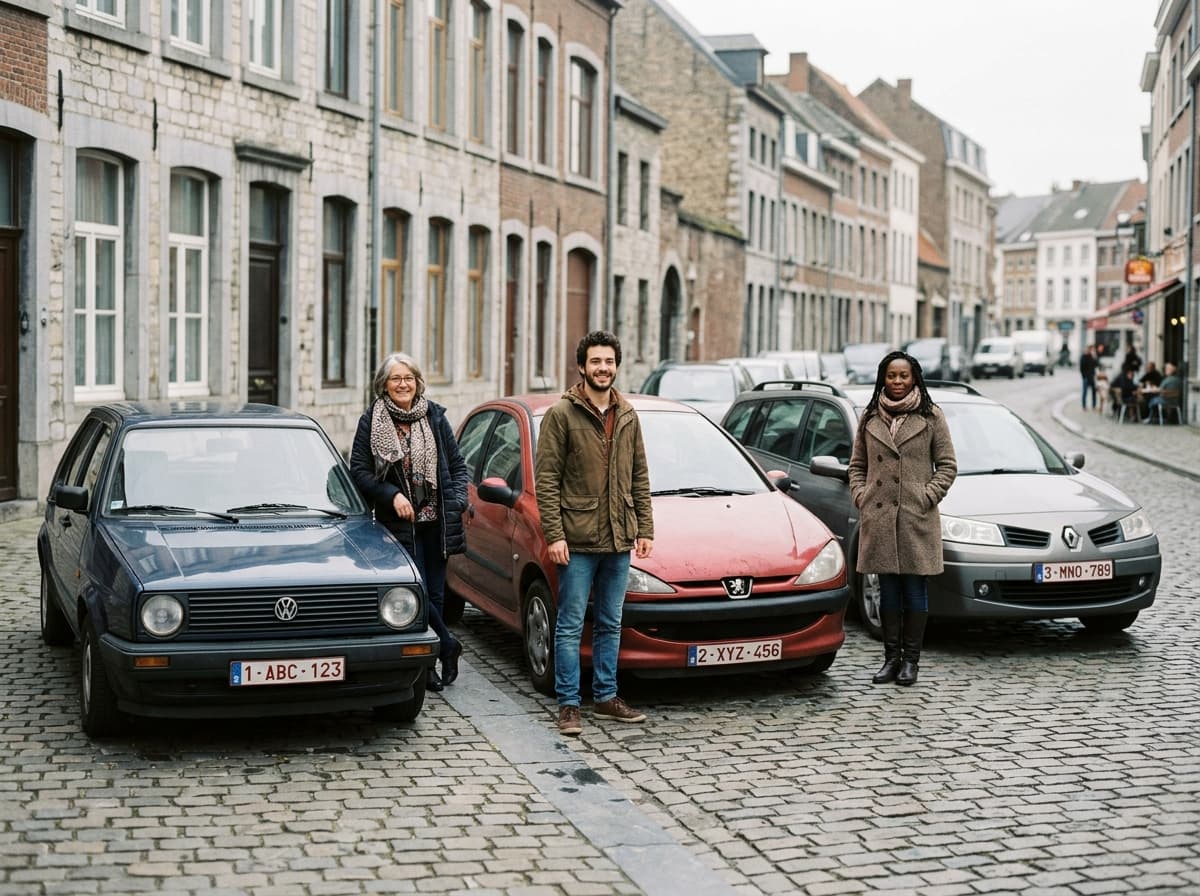
Who can be the policyholder, according to Assuralia?
The Belgian federation of insurance companies answers this in its FAQ, and the answer deserves quoting precisely because no comparison site repeats it.
Assuralia writes that the owner must ensure their vehicle is insured, that this is a legal obligation, but that it matters little to the legislator who ultimately signs the insurance contract, provided that person is an adult. The federation adds two things. First, that the owner has an interest in contracting personally, so as to build their own history. Second, that if you choose your father, your mother or your partner as policyholder, you may in principle do so, on condition that you tell the company who will regularly use the car.
The last sentence of that FAQ is the only one that truly matters: without that disclosure, you risk problems in the event of an accident.
Eight situations, eight answers
The question never arises in the abstract. It always turns up as a concrete case, and the table below covers the ones brokers see every week.
| Situation | Possible in principle | The blocking point | Must be declared |
|---|---|---|---|
| Spouse insures the other's vehicle | Yes | None | Who drives which vehicle |
| Adult child insures the parents' car | Yes | None if the child drives | Actual habitual driver |
| Parent insures the car driven by their child | Not in practice | Habitual driver is false | The young person, as main driver |
| Child insures an elderly parent's car | Yes | Definition of the insured | Who takes the wheel weekly |
| Vehicle on lease or renting | Yes | Lessor's requirements | Cover imposed by the lease |
| Company car | No | Registered to the company | Named driver via fleet manager |
| Vehicle received through inheritance | After registration | Deceased's plate to return | New holder at the DIV |
| Car bought, not yet registered | Yes | Plate must come first | Use and driver at subscription |
One row stands apart from the other seven. The third is the only one where the answer flips not for an administrative reason but because the declaration itself would be untrue, and it is precisely the case half the readers have in mind when they land on this page.
Why does Ethias say no when Assuralia says yes?
Both texts exist, they appear to contradict each other, and nobody puts them side by side.
On its page about insuring a vehicle for a relative, Ethias writes that it is not possible to insure a vehicle on behalf of another person, be it a friend, a family member or a young driver. The insurer justifies its position through the notion of real risk: the premium is built on the age, place of residence, driving experience and occupation of the main driver, and insuring the vehicle in a third party's name amounts to pricing the wrong profile.
Assuralia is talking about the signatory. Ethias is talking about the driver. Both are right, and the contradiction is only apparent, because they answer two distinct questions that search results systematically conflate: who signs belongs to ordinary contract law, who drives belongs to risk disclosure. A contract can perfectly well be signed by the wife and cover a vehicle driven by the husband, provided the husband appears as habitual driver. The arrangement turns irregular at the exact moment the real driver's name disappears from the contract.
The habitual driver is the only declaration that counts
Everything else is secondary.
The habitual driver is the person who uses the vehicle recurrently, as opposed to someone who borrows it now and then. No Belgian text sets a numerical threshold, and intermediaries use more than three uses a month as a practical tipping point. If you insure your mother's car but she is the one doing her shopping with it, she is the habitual driver, whoever signed. If you insure your father's car because you drive it daily, you are the habitual driver, and the contract must say so.
Our article on lending your car in Belgium sets out the boundary between occasional and habitual drivers, along with the insurer's right of recourse.
What is the risk if the main driver was never declared?
The sanction depends entirely on your good faith, and the Insurance Act of 4 April 2014 grades it in three tiers.
Article 58 sets the duty: the policyholder must disclose all circumstances known to them that they should reasonably regard as relevant to the insurer's assessment of the risk. The identity of the person who will drive the vehicle every day falls squarely within that. Article 59 targets intentional concealment that misleads the insurer: the contract is void, and premiums falling due up to the moment the insurer learns of the omission stay with the insurer. Article 60 targets unintentional omission: the insurer may reduce its payout according to the ratio between the premium paid and the premium it would have charged had it known the true position.
The difference at the finish line is brutal. An omission in good faith costs a percentage of the payout; a deliberate one costs the whole contract, premiums included. Our file on forfeiture of cover in car insurance explains how these three sanctions differ from a plain exclusion.
Insuring your child's car in your own name: the calculation that backfires
The gain is immediate, the loss is deferred, which is exactly why nobody sees it coming.
The bonus-malus degree and the claims history are attached to the contract, therefore to the policyholder. A young person driving five years without an accident on their father's policy builds nothing in their own name. The day they leave home and take out their own contract, they hold no personal claims-history certificate, and face the insurer exactly like someone who has never held a steering wheel. Assuralia says so explicitly in its FAQ: signing personally lets you demonstrate over the years that you are a good driver, and obtain that certificate when the time comes.
Five years of reduced premium against five years of lost history. The calculation backfires around the driver's thirtieth year, at the very moment they should have reaped what they sowed. Our guide to car insurance for young drivers in Belgium sets out the regular alternatives, and our article on the Belgian bonus-malus explains how the 0-22 scale is built.
Can a contract require the policyholder to be the owner?
Yes, and that clause genuinely exists on the Belgian market, in a public wording nobody picks up on.
In its assistance FAQ, Touring defines the insured as the natural or legal person who took out the contract and owns the covered vehicle, together with any driver authorised by that person and anyone carried lawfully and free of charge, within the number of seats shown on the registration certificate. The conjunction does all the work. It stacks two qualities instead of offering a choice between them, which means a non-owner subscriber does not meet the definition of the insured in that particular contract.
Hold on to the principle rather than the example: the definition of the insured always sits in the opening pages of the general conditions, it runs to about three lines, and it decides your cover before the list of guarantees even begins. No legal rule imposes it, no legal rule forbids it. Only reading settles the matter.
Do you need the owner's consent to subscribe?
Legally, no. Practically, the question does not arise.
Taking out Belgian car insurance and registering the vehicle form a single process: the insurer or broker files the plate request with the DIV electronically, and the plate is issued to the holder. On an already registered vehicle, the insurer must be able to link the contract to an existing registration, and will ask for the certificate. Without the holder's cooperation, the file stops there, with no need to invoke any legal text at all.
One case is different: a vehicle bought but not yet registered. There, the future holder is indeed the one subscribing, and the insurance comes before the plate.
Five lines to check before signing for someone else's car
The check takes ten minutes and runs across two documents: the particular conditions, which are personalised, and the general conditions, which are shared by every holder of the same product.
- The "policyholder" entry. It names the signatory, the person who pays the premium, receives the correspondence and holds the bonus-malus degree. Make sure it is the intended person, spelling and address included.
- The "owner" or "registration holder" entry. Many Belgian contracts keep it separate from the policyholder, which in itself proves the product anticipates the split. If it is missing, ask the question in writing.
- The definition of the insured, in the general conditions. Look for whether it stacks subscriber and owner, as in the Touring example above, or settles for the subscriber alone.
- The "habitual driver" or "main driver" entry. The name there must be the person who genuinely takes the wheel most of the time. One line, and it is the one that decides whether a claim is paid.
- The exclusive-driving clause. Where present, only the named people may drive, and it comes with a premium discount that explains why it gets signed absent-mindedly.
If any of those five lines remains ambiguous after reading, ask your broker to clarify in writing before signing, not after. Where a disagreement with the company persists, the Insurance Ombudsman handles Belgian consumer complaints free of charge, and the FSMA supervises insurers and intermediaries on the Belgian market.
Which cover works when the policyholder is not the registration holder?
That leaves the choice of cover, which follows its own rules as soon as the car is not yours. An omnium policy taken out by a non-owner compensates damage to the vehicle, and the payout in principle goes to whoever suffers the financial loss, therefore the owner, unless the particular conditions say otherwise. Clarify that point before a claim rather than after, especially between relatives, where the absence of anything in writing turns a dented wing into a family argument.
Three tools for what comes next. Compare market offers on actual cover rather than on the advertised premium, consult the ranking of the best car insurers, which details the terms offered to family set-ups, and take the quiz if you are still unsure which level of cover fits. This site informs and compares; it is not an insurance intermediary and gives no individual recommendation. The decision stays yours, documents in hand.
Profils conducteurs comparator
Compare all profils conducteurs side by side.
Compare now
Frequently asked questions
Grégory conseille des automobilistes belges sur leurs contrats d'assurance depuis plus de dix ans. Il décortique les formules RC, mini-omnium et omnium, compare les compagnies du marché belge et traduit les conditions générales en langage clair. Sa règle : aucune recommandation sans avoir lu les exclusions.