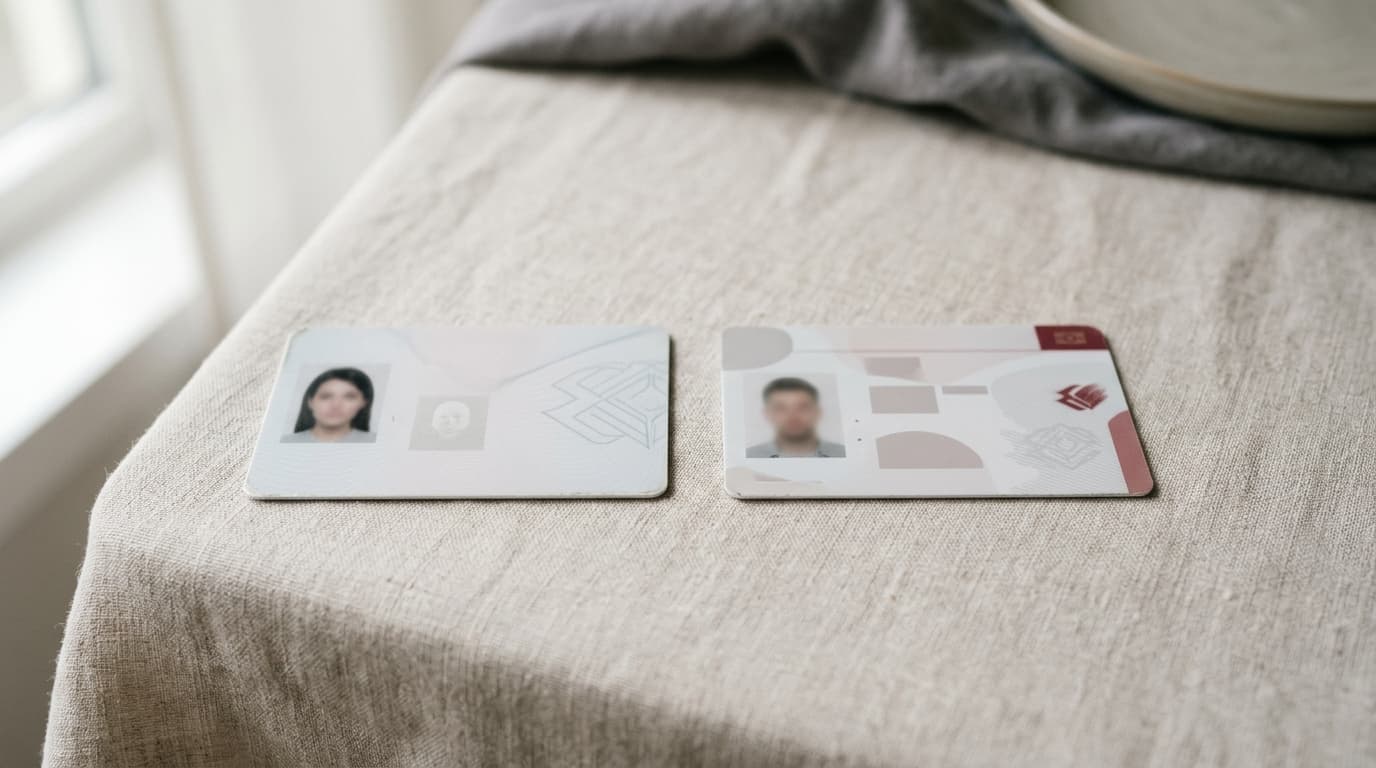
Can you insure a car in Belgium with a foreign driving licence?
Yes. Belgian law makes you insure the vehicle; it does not make you hold a Belgian licence to do so. The insurer, for its part, checks that the named driver is allowed to drive in Belgium on the day of the claim.
Everything turns on that. Not on nationality, nor on which country issued the card, but on whether the licence is valid when the car is on the road.
This article answers "am I covered?" before any accident. For what comes after a claim, our claims and accident report guide takes over.
EU licence or non-EU licence: where is the line?
The dividing line is the European Union and the European Economic Area. A licence issued in an EU or EEA state is recognised in Belgium without any compulsory step, and exchange only becomes necessary in particular cases such as loss, expiry or withdrawal.
A non-EU licence follows another rule. Belgian municipalities, the City of Brussels for example, say you may drive for 185 days after registering in the population register, then must exchange it. Exchange involves authenticating the licence and can take several months. For the conditions and the countries concerned, the official starting point is the FPS Mobility.
A worked example: you register on 1 March 2026. Your non-EU licence stops being valid for driving on 2 September 2026, 185 days later. If the exchange is not complete by then and your municipality has issued nothing that covers you, your car is on the road under a licence that no longer counts.
| Licence situation | Driving in Belgium | Insurer's position |
|---|---|---|
| Valid EU or EEA licence | Allowed, no exchange | Accepted, declare country and date passed |
| Non-EU licence, under 185 days after registration | Allowed | Accepted, in principle same risk profile |
| Non-EU licence, deadline passed, no exchange | Not allowed | Insurer may claim back after a claim |
| Belgian licence obtained by exchange | Allowed | Accepted like any Belgian licence |
| Licence suspended or withdrawn abroad | Check urgently | Risk of refusal or nullity depending on declaration |
What does each cover give you with a foreign licence?
Nothing changes in what the covers contain. It is the licence-validity condition that cuts across all of them.
With third-party liability alone, the victim of an accident is compensated whatever happens, because compulsory insurance protects third parties. With omnium or mini-omnium, cover for your own vehicle also depends on the general conditions: many contracts require a valid licence for the cover to apply, and the insurer may refuse to pay for your own damage if you do not have one.
As for options, legal protection and assistance can also be suspended when the driver did not meet the conditions to drive. It is a point almost nobody reads until a problem arrives. In your general conditions, look for the "exclusions" section and the word "licence" together.
Why does an expired licence not protect you from recourse?
The insurance obligation is not negotiable. The injured third party is compensated even if you were driving without a valid licence. What follows, however, concerns you alone.
The standard contract in the royal decree of 16 April 2018 provides in principle a right of recourse for the insurer in certain situations, including those where the driver did not meet the legal conditions to drive. After paying the victim, the insurer can claim the money back from you. On property damage the amount is bearable. On serious bodily injury, a figure of 200,000 euros is a textbook case, not an exceptional one.
The law of 4 April 2014 on insurance sets strict conditions for exercising this recourse, notably on notification deadlines. They do not relieve you of the need to hold a valid licence.
Does my driving record abroad count for bonus-malus?
Rarely, and never automatically. The 0-22 scale is a Belgian system, where each degree moves your premium and the entry degree applies to new customers. A Belgian insurer has no obligation to take over the claim-free years you built up elsewhere.
Many do agree when the file is solid. Get a statement from your previous insurer showing the length of cover and the claims of past years, translated if it is not in French, Dutch, German or English. Without it you risk being treated as a new customer, at the entry degree of the scale, with the premium that follows.
The detailed calculation belongs to our simulator and the article on bonus-malus in Belgium. Remember only this: the document you gather before signing weighs more than the negotiation you run afterwards.
Must you tell the insurer which country issued your licence?
Yes, without exception. The country of issue and the date you passed are among the elements the insurer uses to assess risk. Leaving them out exposes you to false declaration, governed by the law of 4 April 2014, with a proportional sanction for simple negligence and nullity of the contract where intent to deceive is proven. Our article on false declaration in car insurance details that ladder of sanctions.
Short and plain: declare everything.
If you share the car with a partner or a child who holds another foreign licence, the same logic applies to them. See our guide to the named second driver for the difference between named, regular and occasional, and the one on insuring a car not in your name if the vehicle is registered to a third party, a common situation for new arrivals.
How can you check your cover in ten minutes?
Open your specific conditions, the personalised document, then your general conditions. Go in this order.
- The named driver's licence. Check the country, the date passed and the type of licence shown in the contract. An error here is fixed by a simple email to your broker.
- The words "valid licence" in the exclusions. Note in which cover they appear: third-party liability, omnium, assistance, legal protection.
- The exclusive-driver clause. If it exists, only named drivers can take the wheel, and every foreign licence in the household must then appear in the contract.
- The increased excess. Many contracts double the excess for a young or inexperienced driver, and some treat a recent licence as inexperience, whatever the real driving history.
If you disagree with the insurer, the Insurance Ombudsman handles complaints free of charge, and the FSMA supervises insurers and intermediaries.
What if your current contract ignores your situation?
If you find a gap, act in this order: write to your intermediary to get a documented answer, line your exchange dates up with your municipality's calendar, then compare the covers on the market on what they actually cover rather than the headline premium. The ranking of the best car insurers lists the companies that handle atypical profiles best, and the quiz helps you choose the level of cover if you hesitate between third-party and omnium.
This article informs; it does not replace personalised advice. Your specific conditions, and only they, settle the matter.
Profils conducteurs comparator
Compare all profils conducteurs side by side.
Compare now
Frequently asked questions
Grégory conseille des automobilistes belges sur leurs contrats d'assurance depuis plus de dix ans. Il décortique les formules RC, mini-omnium et omnium, compare les compagnies du marché belge et traduit les conditions générales en langage clair. Sa règle : aucune recommandation sans avoir lu les exclusions.