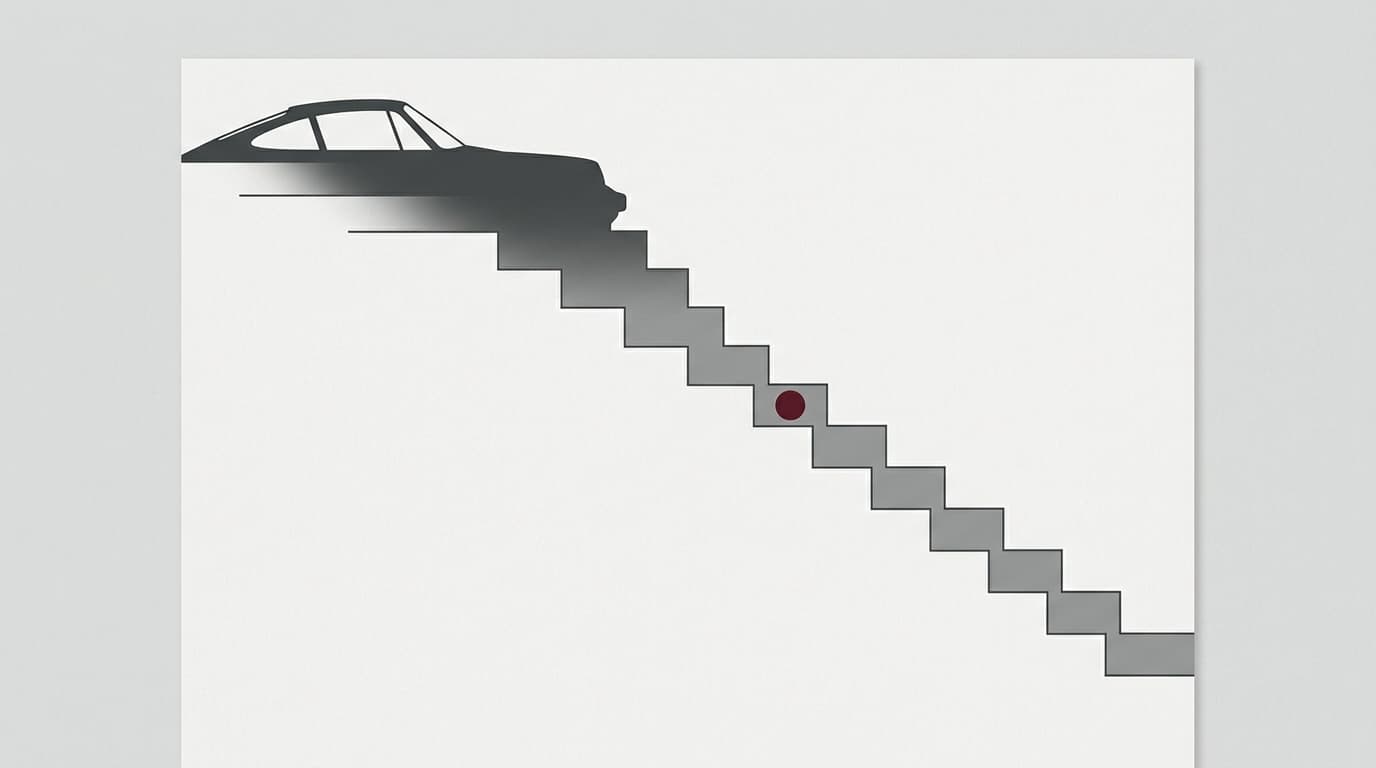
Wear and tear in car insurance: three mechanisms behind one word
In Belgian car insurance, wear and tear (vétusté) is not a single deduction as it is in home insurance. The word covers the depreciation scale applied in a total loss, the exclusion of wear on the vehicle's parts, and the switch to market value once the scale is exhausted. Only the first can be calculated, and it differs from one insurer to the next.
Three mechanisms. One word.
The confusion is expensive because each of the three sits in a different part of the contract and nobody separates them before signing. I read Belgian comprehensive general conditions for this article, and wear and tear almost always appears there under another name.
Why does home-insurance wear and tear not carry over to a car?
Because the pages that dominate the search results talk about walls, roofs and household appliances.
Type « vétusté assurance » and you will land on guides from Luko or Selectra, all devoted to home insurance. They describe a percentage deduction worked out item by item, sometimes recoverable later or buyable back through an option. That is a home-insurance mechanism.
A car does not work like that. A Belgian motor insurer does not keep an item-by-item grid, it reasons on a whole vehicle whose value falls with time. Hence the fair objection: if the car loses value every month, is that not wear and tear already? Yes, and that is exactly what the total-loss scale does. But the objection stops there. It says nothing about repairing a bumper or replacing a wing, where Belgian contracts follow another logic.
Total loss: two Belgian scales, two payouts
This is the only place where wear and tear is truly put into figures, and the gap between insurers is considerable.
The comprehensive conditions of Ethias and the product sheet of Argenta each publish a scale. Here they are side by side.
| Period | Ethias | Argenta, agreed value (VA) | Argenta, agreed value plus (VA+) |
|---|---|---|---|
| No depreciation | First 12 months | First 6 months | First 30 months |
| First step | 1.5% a month from month 13 to 24 | 1% a month from month 7 to 36 | 1% a month from month 31 to 36 |
| Second step | 1% a month from month 25 to 72 | 1.5% a month from month 37 | 1.5% a month from month 37 |
| Back to market value | From month 73 | From month 61 | From month 61 |
Let us run the numbers on an insured value of €30,000, reading each percentage as a cumulative monthly reduction, the same way as in our article on market value, agreed value and new-for-old.
| Total loss in month | Ethias | Argenta VA | Argenta VA+ |
|---|---|---|---|
| 36 | €21,000 (30%) | €21,000 (30%) | €28,200 (6%) |
| 48 | €17,400 (42%) | €15,600 (48%) | €22,800 (24%) |
| 60 | €13,800 (54%) | €10,200 (66%) | €17,400 (42%) |
At sixty months, the same €30,000 car pays €10,200 under one formula and €17,400 under the other, a €7,200 gap with the claim unchanged. These amounts illustrate the mechanism, they are not prices: calculation bases differ between contracts (catalogue value excluding VAT at Ethias, value to be insured at Argenta), and only your own contract is authoritative.
One detail in Argenta's sheet deserves a second reading. It states that the agreed-value payout "will never be lower" than the one based on market value. In other words the scale is a floor, not a ceiling, a guarantee not every contract gives.

Is wear and tear deducted when you repair?
Not as a percentage in the conditions I read, and that is where the confusion with home insurance becomes dangerous.
I went through the Ethias comprehensive conditions in October 2026. The word « vétusté » does not appear. The repair chapter provides for reimbursement of repair costs, non-deductible VAT included, provided you actually and permanently bore it. No per-part reduction grid is published. If you expected a 30% cut on a six-year-old bumper, that contract does not write one in black and white.
That is the good news. The caveat fits in one sentence: another Belgian insurer may write a deduction on certain wearing parts, and a contract that does not mention one does not stop the expert from adjusting the estimate. I am not ruling on your specific conditions. I am telling you where to look.
Wear, poor maintenance, tyres: the exclusion does the work of wear and tear
When the contract does not deduct, it excludes. The effect on your wallet can be the same.
In the "material damage" part of Ethias's comprehensive cover, the insurer rules out damage to vehicle components "resulting from wear, a defect of construction or material", and from "manifest poor maintenance" of those components. A little further on, tyre damage is excluded unless it occurs together with other covered damage. A puncture on its own is therefore not reimbursed, whereas vandalism to tyres is, provided a complaint is lodged within 48 hours.
These are the checkpoints I apply to any Belgian comprehensive policy:
- Wearing parts. Brakes, clutch, belts, shock absorbers: check whether they are named or caught by a general formula.
- Tyres. Find the exact rule (excluded alone, covered with other damage, covered in case of vandalism) and the complaint deadline.
- Poor maintenance. The qualifier matters: "manifest" protects you more than "insufficient".
- Roadworthiness certificate. An expired certificate is among the exclusions at Ethias and Argenta. It is an obligation rather than wear, but it is read in the same place.
Forfeiture of cover follows another logic, detailed in our article on forfeiture of cover: an exclusion describes a risk never insured, forfeiture sanctions a breach of an obligation.
Can you buy back or recover wear and tear in car insurance?
Home insurance talks about recoverable wear, and that expression does not appear as such in a comprehensive car policy.
The car equivalent is to choose a formula with a long period before depreciation starts. Argenta's VA+ agreed value, with its 30 months without reduction, plays that role, and it is what the Belgian market sometimes calls "new value" or "purchase value". You pay for that comfort in the premium, and you stop benefiting from it when the payout returns to market value (month 73 at Ethias, month 61 at Argenta). Past that month, no scale-based option brings anything more.
The usual caveat applies: a buy-back option for wear on parts may exist at an insurer I have not read. Ask for it in writing rather than assume it.
How do you check wear and tear in your own policy?
Ten minutes, one PDF, four searches.
- Search « vétusté » then « dépréciation ». If the first word is missing and the second present, you have a total-loss scale and nothing else. Belgian policies come in French or Dutch, so search the language of your document.
- Note the two figures of the scale. Number of months without reduction, then the monthly percentage of each step, up to the month the payout returns to market value.
- Search « usure », « entretien » and « pneu ». Note the article number of each exclusion you find.
- Open your specific conditions. The regime you actually bought is there, and it prevails over the standard text, as our article on specific conditions explains.
Three lines to note before signing
Wear and tear reads in three steps, and only the first appears on a price grid.
Step one: the total-loss scale, with its months without reduction and its month of return to market value. Step two: the exclusions for wear, poor maintenance and tyres, which play the part of a deduction without bearing its name. Step three: market value, which takes over and which the expert rebuilds from the market, with no percentage added.
To compare contracts on these criteria, our ranking of the best car insurers goes through them one by one, the comparison tool sets them side by side, and the quiz frames in two minutes which type of formula suits the age of your vehicle. If you hesitate over the level of cover, our comparison mini-omnium vs full omnium details what each formula pays and refuses.
If the claim has already happened and the amount looks low, the ground becomes procedural: second opinion, legal protection, mediation. The Insurance Ombudsman handles Belgian consumer complaints free of charge, the FSMA, the Belgian financial services and markets authority, supervises insurers and intermediaries, and the Wikifin portal explains how comprehensive payouts are calculated.
The extracts quoted come from public Ethias and Argenta documents consulted in October 2026. They illustrate Belgian market practice and do not replace your own specific conditions.
This site informs and compares. It is not an insurance intermediary and gives no individual recommendation.
Formules & garanties comparator
Compare all formules & garanties side by side.
Compare now
Frequently asked questions
Grégory conseille des automobilistes belges sur leurs contrats d'assurance depuis plus de dix ans. Il décortique les formules RC, mini-omnium et omnium, compare les compagnies du marché belge et traduit les conditions générales en langage clair. Sa règle : aucune recommandation sans avoir lu les exclusions.