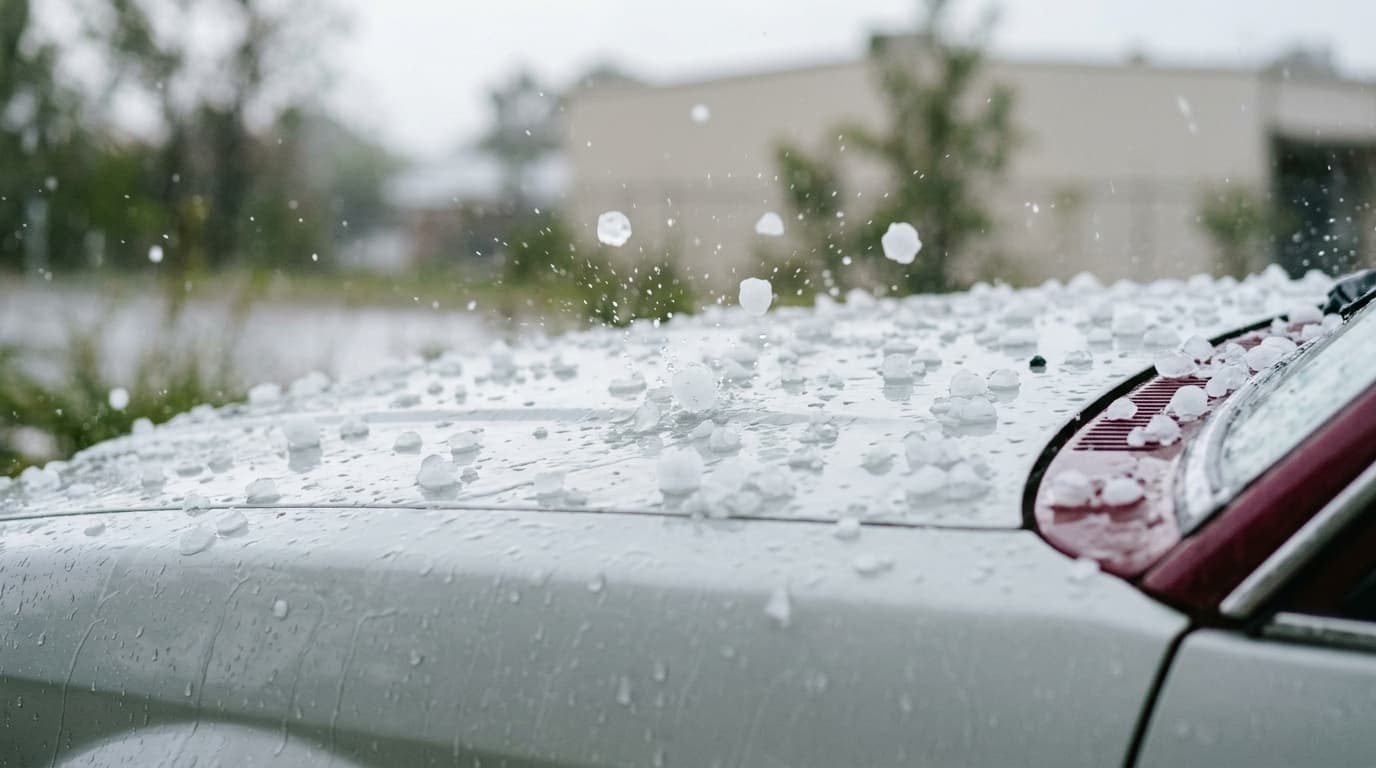
No, if all you hold is compulsory liability cover. In principle yes, if your policy contains a natural forces guarantee: mini omnium, full omnium, or an add-on sold separately on top of liability cover. Between those two answers, a handful of clauses set the amount actually paid, and they sit quietly in the general conditions.
Is hail covered by your car insurance?
Only if a « forces de la nature » guarantee, meaning natural forces, sometimes worded « éléments naturels », appears in your policy. Third-party liability insurance (RC), the only compulsory motor cover in Belgium, pays for damage you cause to others. Your dented bodywork is not part of it.
The table follows the formulas as they are sold on the Belgian market. It describes common practice, not your policy: only your particular conditions count.
| Cover held | Bodywork dents | Windscreen and windows | Crash during the storm | Deductible to expect |
|---|---|---|---|---|
| Liability only | No | No | Not for your car, liability pays the third party | Not applicable |
| Liability and glass cover | No | Yes in principle | No | The glass cover deductible |
| Liability and natural forces add-on | Yes in principle | Yes in principle | Check, rarely included | Zero at an approved repairer, 250 euros elsewhere (OmniNature) |
| Mini omnium | Yes in principle | Yes in principle | Often no: direct damage only | Variable, sometimes zero |
| Full omnium | Yes in principle | Yes in principle | Yes in principle, through material damage | The material damage deductible for the crash |
The fourth column surprises people most. I come back to it below.
Mini omnium, full omnium or add-on: which pays for hail?
All three, provided the natural forces guarantee has actually been taken out. The choice between them depends on the car's value and on whatever else you want covered, not on hail itself.
Mini omnium, which AG Insurance calls « Multirisques », usually bundles fire, theft, glass and natural forces. Full omnium adds material damage, meaning the accident you cause yourself. For hail alone, mini omnium is therefore enough; the boundary between the two is set out in our mini omnium vs full omnium comparison.
That leaves the car too old to justify an omnium. The Belgian market offers a third route: AG Insurance sells, through BNP Paribas Fortis, an OmniNature guarantee that sits on top of liability cover and covers hail, flooding, storms and windows without any other omnium guarantee around it. It was launched in January 2016 on a finding the insurer put into figures itself, namely that roughly one car in two was then driving without omnium, so without hail protection. The Whitsun storm of 2014 had triggered more than 70,000 motor claims, and according to the Royal Meteorological Institute (IRM) as quoted by the company, Belgium sees on average five to six storms a year with hailstones of at least 2 cm, a size that is enough to mark bodywork.
A marker before you sign. On an older car, a heavy storm can produce a repair quote close to the market value, and the assessor will then declare a total loss, paid on the value of the day rather than on the cost of repair. The mechanism is explained in our article on market, agreed and new-for-old value.
Is glass cover alone enough?
For the windscreen, in principle yes. For a bonnet peppered with dents, no: glass cover only knows glass, as our reading of glass cover shows.
Hail while driving: direct or indirect damage?
That is where the whole difference lies, and almost nobody reads it before the storm.
A natural forces guarantee pays direct damage, the hailstone denting the roof. Belgian consumer organisation Test-Achats notes that most smaller omnium policies stop there. Indirect damage is the storm making you skid into a post: without a clause including it, that impact stops being a hail claim and becomes an accident, which falls under material damage cover, absent from a mini omnium. If another car is hit, your liability cover pays its owner. Yours stays at your expense.
Search your general conditions for the words « directs » and « indirects » near the definition of the guarantee. Their presence, or absence, answers the question.
Which exclusions should you read before the storm?
I never recommend a formula without having read its exclusions, and hail cover has more of them than people think. The public product page for the OmniNature add-on, for example, rules out loss of value and thrown gravel in black and white. The clauses that come up most often in Belgian policies:
- loss of value of the vehicle after repair, excluded by the OmniNature add-on;
- unavailability costs while the car is off the road, also excluded;
- gravel or chunks of ice thrown up, which are not hail within the meaning of the policy;
- indirect damage, where the guarantee is limited to direct damage;
- earlier damage never reported or proven, a common reason for refusal when the assessor separates old and new dents;
- the 80 km/h wind threshold, which applies to storms, not to hail.
The last point deserves one more line. Several Belgian policies define a storm as wind of at least 80 km/h measured within 10 km of the vehicle: during a storm without strong enough gusts, the hailstone dents are covered, the branch that fell on the roof not necessarily.
What deductible and what malus for a hail-damaged car?
No malus. The Belgian bonus-malus scale, from 0 to 22, only moves after a liability claim where you are at fault; hail damage falls under omnium and involves no fault, as detailed in our article on bonus-malus. An insurer remains free to revisit its pricing at renewal after several claims close together, but that is a different mechanism.
The deductible, for its part, depends on the policy and often on the repairer. Many omnium policies apply none to natural forces; others set one, fixed or proportional, sometimes waived at an approved body shop.
Take a dent repair quote of 2,400 euros, an order of magnitude consistent with the average hail claim that AG Insurance already put above 2,000 euros in 2016. Under the OmniNature add-on, repair at an approved repairer is paid in full, and at the garage of your choice the 250 euro deductible leaves 2,150 euros. On a hypothetical mini omnium with a fixed 400 euro deductible, 2,000 euros would remain. Three policies, three amounts for the same metal.
Without omnium, does regional aid step in?
Rarely for a hail-damaged car. The Regions can compensate damage when a natural event is recognised as a disaster, but two limits rule out most cases: purely cosmetic damage, such as hail dents, is never compensated, and Brussels and Wallonia do not pay out for cars under five years old. The claim is filed after the recognition is published in the Moniteur belge, the official gazette, and no later than the last day of the third month that follows. The rules depend on the Region where the damage occurred: Wallonia, Brussels or the Flemish Rampenfonds.
Counting on that safety net for bodywork means counting on nothing.

Six lines to check in your particular conditions
Open the PDF and switch on search. Ten minutes are enough.
- Type « grêle » (hail) and « forces de la nature » (natural forces). No hit among the guarantees you hold means no cover, whatever the formula's trade name.
- Search for « directs » and « indirects » around the definition: you will know whether a crash caused by the storm is included.
- Note the deductible specific to natural forces, often separate from the general deductible, and the approved-network condition that cancels it.
- Read the exclusions that follow the definition: loss of value, unavailability, thrown gravel, tyres alone, undeclared accessories.
- Check the insured value, market, agreed or new: it decides the payout in a total loss.
- Note the reporting deadline. The standard Belgian liability policy requires eight days; your omnium sets its own, worth knowing before you need it.
The step-by-step reading of particular conditions shows where each of these mentions sits.
Hail: the right move for your situation
| Your situation | Hail covered? | What to do before the next storm |
|---|---|---|
| Liability only, recent car | No | Add a mini omnium with natural forces |
| Liability only, older low-value car | No | Ask whether your insurer sells a natural forces add-on |
| Liability and glass cover | Windows only | Compare the extra premium for a mini omnium |
| Mini omnium | Yes in principle, direct damage | Check the indirect damage clause and the deductible |
| Full omnium | Yes in principle | Check the deductible outside the approved network and the insured value |
| Car already marked by an earlier storm | Old dents excluded in principle | Photograph and date existing damage when you sign up |
| Company or leased car | Depends on the owner's policy | Ask the lessor for the written list of guarantees |
To set formulas side by side on those three lines, the car insurance comparison tool lines up the guarantees and the ranking of the best car insurers sets out what each company covers and refuses. The quiz helps you settle the level of cover your car needs. If the storm has already passed, the route is set out in our article on reporting a car insurance claim.
Belgian car insurance contracts are governed by the Insurance Act of 4 April 2014. Where a disagreement over the scope of a guarantee persists, the Insurance Ombudsman, the free Belgian complaints service for insurance customers, examines consumer complaints, and the FSMA, the Belgian financial services and markets authority, supervises the conduct rules of insurers and intermediaries. The terms of the add-on mentioned are public: the OmniNature product page links to its general conditions and information document.
This site informs and compares. It is not an insurance intermediary and gives no individual recommendation.
Formules & garanties comparator
Compare all formules & garanties side by side.
Compare now
Frequently asked questions
Grégory conseille des automobilistes belges sur leurs contrats d'assurance depuis plus de dix ans. Il décortique les formules RC, mini-omnium et omnium, compare les compagnies du marché belge et traduit les conditions générales en langage clair. Sa règle : aucune recommandation sans avoir lu les exclusions.