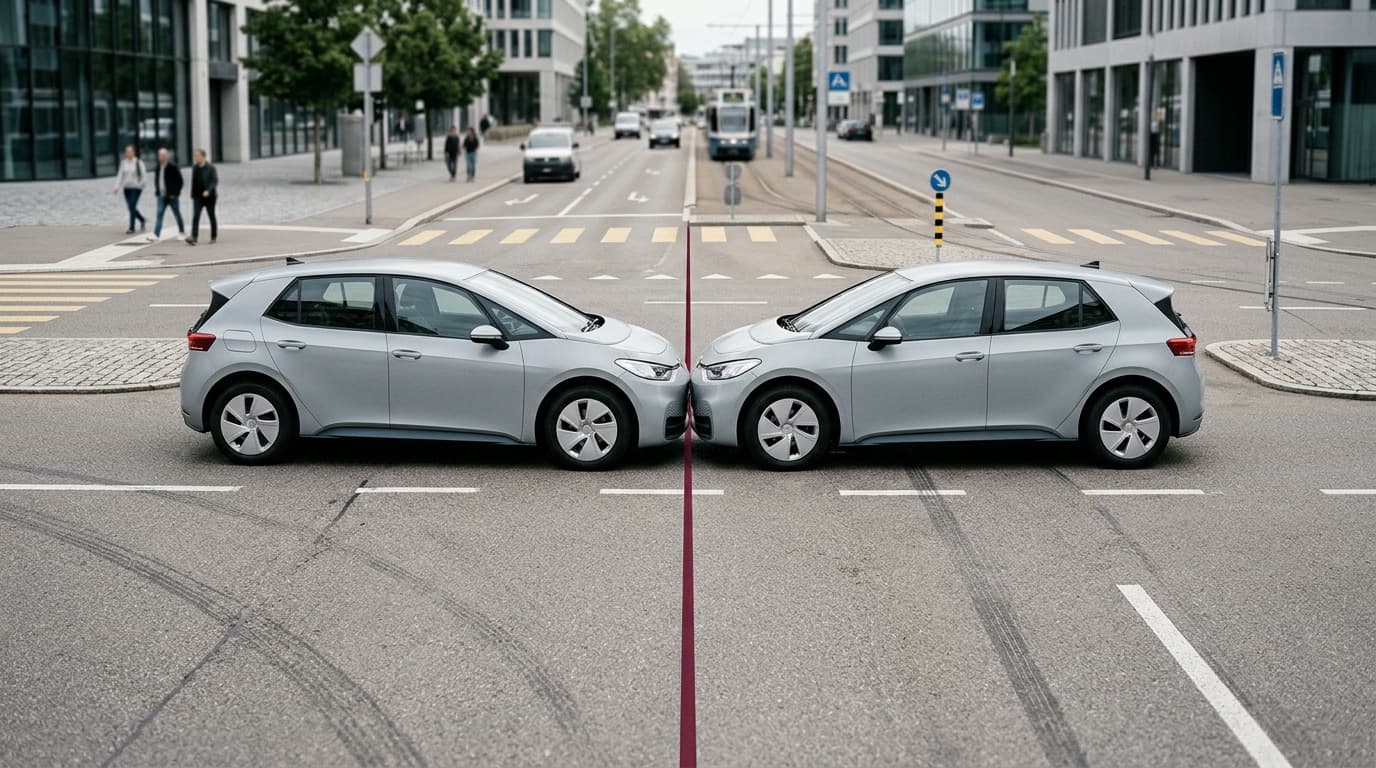
At fault, your liability insurance pays the other driver, never your car. Not at fault, the other driver's insurer pays you, with no deductible and no malus. With shared fault, each side recovers the other's share. Three statuses, three very different bills, and only one moment to choose the cover that will apply: before the accident.
Three statuses, three bills
Fault is the share of responsibility assigned to you in an accident, from 0 to 100 %. Fault, not the severity of the crash, decides which insurer opens its wallet.
The table crosses the three statuses with the three cover levels sold in Belgium. It applies to your own material damage, the damage to your own car. In Belgium, « RC » means compulsory third-party liability, and « omnium » means own-damage cover: mini-omnium for named perils, full omnium for collision too.
| Your status | Liability (RC) only | Mini-omnium | Full omnium | Malus |
|---|---|---|---|---|
| At fault (100 %) | Nothing for your car | Nothing for an at-fault collision | Repair paid, minus deductible | In principle, yes |
| Shared fault (50/50) | 50 % paid by the other insurer | 50 % from the other insurer, nothing more | 50 % from the other insurer, the rest from your omnium with deductible | Possible, depending on the insurer |
| Not at fault (0 %) | 100 % paid by the other insurer | 100 % from the other insurer | 100 % from the other insurer | No |
The mini-omnium column often surprises people. It covers named perils, theft, fire, broken glass, natural forces, hitting an animal, and not a collision with another vehicle when you caused it. Our comparison of mini-omnium vs full omnium sets out that scope line by line.
At fault: who pays for the damage to your car?
You do, unless you took out full omnium.
Compulsory liability cover pays the victims you cause: the other driver, their passengers, the cyclist, the pedestrian. It never touches your own vehicle. Argenta says so plainly in the product sheet for its car insurance (April 2024 edition): under liability cover, damage to your own car and bodily injury to its driver are not insured. Your injuries as a driver fall under a separate cover, driver injury insurance.
The victim, on the other hand, is paid in full. Article 151 of the Insurance Act of 4 April 2014 makes deductibles, exclusions and forfeitures unenforceable against the injured party: your insurer compensates the other driver entirely, even if your policy includes a liability deductible. It can then claim that deductible back from you, or exercise wider recourse in the cases set by the Royal Decree of 16 April 2018, such as drink-driving or an invalid licence. Our article on subrogation and recourse puts figures on those cases.

Not-at-fault accident: do you pay a deductible?
In principle, no. When the other driver carries full responsibility, their liability insurer compensates you: repair, loss of value, related costs, injuries. Your policy is not used, so neither its deductible nor your bonus-malus step moves.
There is a practical catch. The other insurer may drag its feet, dispute the circumstances or wait for the signed accident report. If you hold full omnium, you can ask your own company to pay you straight away. It will then withhold its deductible, turn to the party at fault and, in most files, recover that deductible too and refund it to you. Ask for this explicitly: it is not always automatic.
Shared fault: the maths on a 3,000 euro repair
A badly judged lane change, two cars reversing at the same moment in a car park, and the insurers conclude that responsibility is shared, often 50/50. Each then compensates the other in proportion to their own customer's fault.
Take a 3,000 euro repair on your car, a 50/50 shared fault and a fixed omnium deductible of 450 euros, one of the amounts Argenta publishes for its Full Omnium Base plan.
- Liability only: the other insurer pays you 1,500 euros. You are left with 1,500 euros to pay.
- Full omnium: the other insurer pays 1,500 euros, your omnium takes the remaining half minus the deductible, so 1,050 euros. You are left with 450 euros.
- Same accident, fully at fault: 3,000 euros out of your pocket with liability only, 450 euros with omnium.
The gap between the two cover levels, 1,050 euros, is exactly what own-damage cover buys you on this single claim. Some policies withhold only part of the deductible when fault is shared; others withhold all of it. The rule sits in your general conditions, in the own-damage chapter, and nowhere else.
The malus follows the fault, not the deductible
This is the most common mix-up.
The deductible depends on which cover pays. The malus depends on the fault assigned to you. The two mechanisms are independent, and paying a deductible saves you no steps. Belgium uses a bonus-malus scale running from 0, the best, to 22, the worst. With most Belgian insurers, an at-fault claim pushes you five steps up that scale, while a claim-free year takes you only one step down: it takes roughly five years of clean driving to erase a single at-fault accident. Since 2004 the law no longer imposes a scale and each company sets its own, so a shared fault may count as a full claim with one insurer and as half a claim, or nothing, with another. Our guide to the Belgian bonus-malus explains the scale, and the claims history certificate shows how that fault follows you from one insurer to the next.
Car park accident: who is at fault?
Most of the time, the driver who is manoeuvring. Article 12.4 of the Belgian Highway Code requires a driver performing a manoeuvre, reversing, pulling out of a space, turning around, to give way to other road users. Two cars reversing at the same moment therefore often end in shared fault.
In a car park, the claim that hurts your budget most is often a different one: the scratch or dented door with no one identified. No fault, no one to claim from. Only the own-damage cover of full omnium applies, minus the deductible, and our article on car vandalism shows where the line with a deliberate act runs.
Three Belgian policies read at the « deductible » line
On 25 October 2026 I read the public documents of three insurers to see how the deductible behaves when you are at fault. None of them says the same thing.
Argenta publishes fixed deductibles, 450, 750 or 1,250 euros on Full Omnium Base, 250 or 450 euros on Comfort, and states that they do not apply in a total loss. The product information document for DVV Mobility (October 2024) limits the omnium deductible to the own-damage cover alone and offers an « English deductible » option, a threshold below which the insurer pays nothing, which our article on the English excess takes apart. The document for Beobank car insurance, underwritten by ACM Belgium (September 2025 edition), provides for a higher deductible if repairs are not carried out by an approved repairer, and an additional deductible when the driver is under 26.
Three policies, three ways of charging you for the same at-fault scrape. Before you sign, check in your particular conditions:
- the own-damage deductible amount, and whether it is a fixed sum, a percentage or an English threshold;
- the rule for shared fault: full, reduced or proportional deductible;
- surcharges linked to the driver's age, an undeclared driver or the choice of garage;
- the cases where the deductible is waived, total loss or repair within the approved network;
- the bonus protection clause, where there is one, and how many at-fault claims it neutralises.
Which cover suits your risk of being at fault?
Nobody plans to cause an accident. The useful question is how much you could pay out of your own pocket if it happened tomorrow.
To place each company on its cover levels and deductibles, the ranking of the best car insurers is the starting point, the quiz settles the right level of cover in two minutes, and the comparison tool sets offers side by side. If an accident has already happened, the next steps are in our article on reporting a claim. If you disagree with your insurer about the fault assigned to you, the Insurance Ombudsman, the free Belgian complaints service for insurance customers, examines the dispute, and Wikifin, the financial education portal run by the FSMA, Belgium's financial services and markets authority, explains the basics of an insurance contract.
This site informs and compares. It is not an insurance intermediary and gives no individual recommendation: your general and particular conditions, and only they, decide.
Formules & garanties comparator
Compare all formules & garanties side by side.
Compare now
Frequently asked questions
Grégory conseille des automobilistes belges sur leurs contrats d'assurance depuis plus de dix ans. Il décortique les formules RC, mini-omnium et omnium, compare les compagnies du marché belge et traduit les conditions générales en langage clair. Sa règle : aucune recommandation sans avoir lu les exclusions.